Raising a child requires profound strength and hope. You must believe in your ability to forge a future that is better than the one we currently inhabit, even if you never live to see it.
– Angela Garbes, Essential Labor: Mothering as Social Change
I don’t know what’s coming. I do know that, whatever it is, some of it will be terrible, but some of it will be miraculous, that term we reserve for the utterly unanticipated, the seeds we didn’t know the soil held. And I know that we don’t know what we do does. As Shane Bauer points out, the doing is the crucial thing.
– Rebecca Solnit, “The Arc of Justice and the Long Run”
What is grief, if not love persevering?
– Vision, from Marvel’s WandaVision
This book is a love story.
It’s also a grief story.
Here’s the love story.
I started this book in 2018. I never thought I’d write a book, or wanted to, even though I’ve always been a writer. I’d been intensely shy in school, so what I couldn’t say aloud, I wrote down. I was lucky enough to have teachers who noticed and encouraged me to write more. It’s partly because of those teachers that I became a teacher: they saw something in me and created a space where that something could be heard and known.
I didn’t consider teaching as a career until I was more than halfway through college. I loved reading and writing, I enjoyed being around people, and I believed in the powerful role that schools had in a democracy. Teaching seemed a good fit.
Sometime during those early years in the classroom, I fell in love. I loved being a high school English teacher. I didn’t always love everything I taught, or decisions that were out of my control, and I definitely did not love all that came with having to navigate a predominantly White profession—but I loved teaching, and I loved being with young people. I loved seeing the ways students were challenged and challenged each other, I loved the way they asked the best questions and were funny when they didn’t mean to be. I loved how smart and wise they were, even when they didn’t always make the smartest or wisest decisions. I loved that I had things I could teach them, and I loved how there was always something new they taught me. I loved the way we built community in the classroom together, day in and day out. I loved it all—even on the hardest of hard days.
Perhaps especially on those days.
I also loved working side by side with colleagues who were as smitten with kids as I was. Over the years, I found community with fellow teachers—both in and out of school, in the classrooms next door and in classrooms across the country—who pushed me to be a better version of myself. I loved their creativity, and I was continuously awed by their talent for finding ways to make learning relevant and meaningful for the kids sitting in front of them. I loved nerding out with people who laughed at the same teacher puns I did but who also cried with me on those heart-wrenching days after. Days like the ones after Parkland, where a shooter gunned down seventeen people at Marjorie Stoneman Douglas High School in 2018 in Florida. And the many days after March 2020, when the World Health Organization declared the global COVID-19 outbreak a pandemic and the world turned upside down.
And now here’s the grief story.
I started this book in 2018. As I began closing in on my second decade of teaching, and with the encouragement of some friends and mentors, I realized that some of the things I did in the classroom might be helpful for others. This book could be a humble contribution, an offering, to our collective conversations about teaching and learning.
This book was set to be published in late 2020—and then the world turned upside down.
I stopped writing.
As frightening images of the pandemic filled our screens, essential workers and frontline nurses and doctors in head-to-toe protective gear, the rest of us retreated into our homes and held our collective breath. Then the entire world bore witness to the murder of George Floyd and images of the largest civil rights protests in the nation’s history filled our news feeds. Violent acts of anti-Asian hate, particularly against Asian elders, added another level of worry for my own elderly parents’ health and safety. And amidst all of this, I had students to teach.
Like many educators across the country, I spent every spare minute trying to adjust curriculum, figure out how to screen-share, create break-out groups, teach kids at home and in-person simultaneously, to keep learning going, sometimes, it seemed, at all costs. And like many parents, I also had my own children at home. Looking back, the stack of N95 masks and hand sanitizer were woefully insufficient, but it felt like the least I could do to keep my family safe.
I was about 75-80 percent finished with the manuscript for this book, but I couldn’t write a single word. How could anything I wrote matter when we were all just trying to survive?
Much has been written about how the pandemic revealed the weaknesses in many of our systems—from healthcare and social welfare, economics and education. When each of these systems was challenged by the pandemic, the weakest parts of each of them were strained and exposed. When the news began reporting that the pandemic was having a disproportionately negative impact on Black and Brown communities and calls to “open” schools and businesses soon followed, it became clear whose lives were considered essential and disposable. Of course, this wasn’t news to anyone with an understanding of history, but that didn’t mean it hurt any less.
Teaching had always been demanding work. Yet even before the pandemic, I could feel the work I was doing—teaching full time and facilitating much of the equity work in my department and school—was becoming unsustainable. But I was sustaining it. I was doing what many women, and especially women of color, do—I was figuring it out. The work was too important.
A few days after six Asian women were killed at an Atlanta spa in March 2021, I found myself sitting alone, behind my plexiglassed desk, and just. . . sobbing. Everything that I had been so skilled at holding in—every racial trauma and hurt I’d experienced and that I’d compartmentalized—now refused to stay quiet. My insides screamed. I could no longer explain away or unsee the way people and systems showed up during the pandemic, after George Floyd, after those six women were killed. I couldn’t understand how reimagining education really meant keeping the status quo. And so even though there was so much and so many to love where I was, there was also too much to bear.
In June 2021, and after twenty years, I made the decision to leave the school where I had fallen in love with teaching and kids.
I’ve been grieving every day since.
That grief has nothing to do with regret, however.
Though my work looks different now in my current school and in this new leadership role, I still get to teach and spend time with young people. Not a day goes by that I’m not reminded of how important social justice, antibias education is. It didn’t take very long for me to fall in love with sitting in a circle with four-year-olds, as they learn to appreciate that what makes us different—whether it’s the people in our families, the melanin in our skin, or the foods we love to eat—also makes us stronger. Every day, I’m humbled and honored to be sitting with middle schoolers who are vulnerable and brave enough to share their truths in ways that take my breath away.
Life—for me and I suspect for many others—is often marked by a before and after, an indelible moment that changes forever how we move in the world. My teaching life has a before and after, marked by a pandemic whose effects none of us have even begun to understand. Fights about mask mandates have been replaced by book banning crusades and anti-LGBTQ laws that put kids’ lives in danger. The list of things to fight against is relentless.
When I put this manuscript down and stopped writing three years ago, I struggled because I wasn’t sure that anything I had to say mattered. When I picked it back up again, however, I struggled because I realized that everything I’d written did matter. It was painful to reread words I’d written before the pandemic, before I left the only school I’d ever known as a teacher. Revising and revisiting this “before” time made all the old griefs fresh again.
But then I was reminded that you can only experience grief after experiencing love. Like I said, this book is a grief story, but it’s also a love story.
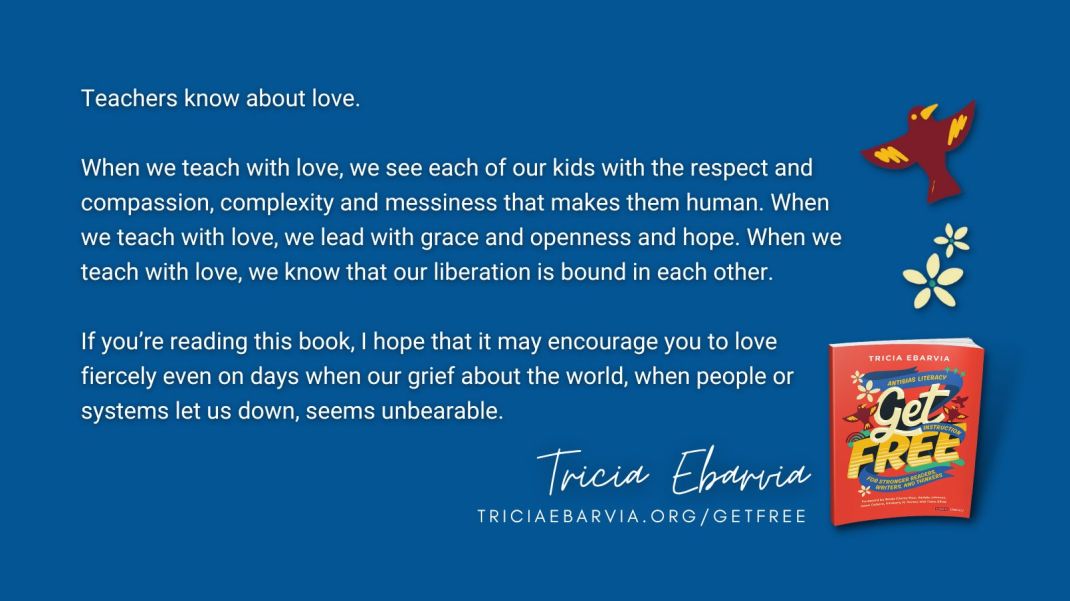
Teachers know about love. When we teach with love, we see each of our kids with the respect and compassion, complexity and messiness that makes them human. When we teach with love, we lead with grace and openness and hope. When we teach with love, we know that our liberation is bound in each other. If you’re reading this book, I hope that it may encourage you to love fiercely even on days when our grief about the world, when people or systems let us down, seems unbearable.
Perhaps especially on those days. Because the list of things to fight for is everlasting.

This post in an excerpt from Get Free: Antibias Literacy Instruction for Stronger Readers, Writers, and Thinkers (Corwin, October 2023). All rights reserved.
 Tricia Ebarvia
You must be logged in to post a comment.