Participating in the “Slice of Life” challenge for the first time this month reminded of how important it is to keep the creative well going.
It also reminded me of two questions that serve as useful reminders for what matters. Read More
Participating in the “Slice of Life” challenge for the first time this month reminded of how important it is to keep the creative well going.
It also reminded me of two questions that serve as useful reminders for what matters. Read More
Even though we had no school on Thursday and Friday thanks to Winter Storm Thor (a name my superhero-crazed sons appreciated), I haven’t gotten much done with the extra time. As much as I enjoy the time off—and the customary sledding, hot chocolate, and pajamas-all-day—I always foolishly think of snow days as days I can “get things done.” After a record number of snow days last year during which I was equally unproductive—and that resulted in a school year that ended on June 31st!—I should really know better.
I used to be someone who liked lists. When I was in high school and college, I loved writing things down in my planner just to have the satisfaction of crossing things off when I finished.
I don’t like lists anymore. At some point, my lists became so long that I felt defeated just looking at them. Read More
Last night, Matthew asked me for help on his math homework. He is in fourth grade, and they are currently working on a unit on division. His end-of-module test was supposed to be this week (we’ve had two snow days), and the review packet included the following problem:
He had no difficulty solving the problem using long division, but he was also asked to solve using “place value disks.” He had solved the problem using this second method, but his answers weren’t matching, which meant one of his strategies had an error.
If you’re a high school teacher like I am, or like most parents it seems, this might be confusing. It was to me. Read More
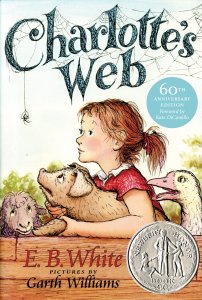 I’ve been reading Charlotte’s Web to the boys, just a chapter or two a few nights a week.
Charlotte’s Web was one of my favorites growing up. I didn’t have the words for it back then, but I knew that there was something special about reading E. B. White’s classic. I remember feeling completely overwhelmed by the story—touched by Charlotte and Wilbur’s friendship. I was overwhelmed by Charlotte’s kindness when she saved Wilbur’s life. And I was overwhelmed with grief when Charlotte died, leaving her small children behind. My heart ached.
I see now that reading Charlotte’s Web was an important experience for me. Read More
“Daddy, can you be the narrator?” I hear one of the boys ask my husband.
Whenever the boys play together—whether it’s with their Legos, Star Wars figures, or super heroes—they usually assign someone to play the role of the “narrator.” Read More
With the popularity of dystopian literature, I guess it’s only fitting that I find myself sometimes wondering if I do, in fact, life in a dystopian society. And I’m not even referring to the 1984-esque Patriot Act or the Generation Like of Brave New World. And though there are times I wonder if high school isn’t some slightly tamer version of The Hunger Games, that’s not what I’m talking about either.
No, what I’m living in is something more like the world of “Harrison Bergeron.”
The long-anticipated season 3 of House of Cards was released on Friday. While some of us joked at lunch last week that we’d be glued to our TV sets this weekend, I’m not sure how many of us actually got to spend all that quality time with our favorite politically savvy, morally bankrupt couple. If there’s never enough time to read all the books on our “on-deck” list, then there’s even less for all the TV that’s out there (maybe this summer will finally be the one I tackle Breaking Bad).
Regardless of the merits (or not) of sitting in front of a television for 13 hours straight, what I really want is more time. Read More
This year, I rededicated myself to helping students find their “readerly lives.” I actually started to do more independent reading with my students three years ago after I read Readicide, but it wasn’t until this year that I felt like I understood what it really meant to help students discover who they are as readers. What I discovered, of course, is that in order to help students find books that will speak to them, I had to read books that would appeal to them, even if they weren’t the books I’d typically read. After all, how can I recommend books to certain students when I don’t know what books to recommend? So for the last year two years, my reading life has included several YA titles. Read More
Presented at Tredyffrin-Easttown School District Language Arts Standing Committee, February 2015 Read More
 One of the last books I read in 2014 was Gabrielle Levin’s delightful novel, The Storied Life of A.J. Fikry. At one point, the main character—a somewhat odd and sometimes churlish bookseller named A.J. Fikry—tells his daughter to remember that “the things we respond to at twenty are not necessarily the same things we will respond to at forty and vice versa. This is true in books and also in life.” He adds, “Sometimes books don’t find us until the right time.”
Many years ago when I first read The Great Gatsby in high school, I didn’t like it very much. I remember listening to a classmate discuss how much she loved the book. “Gatsby,” she gushed, “The way he could change his entire life to win Daisy over? It’s soooo romantic.” I didn’t get it. I’d read the same book but I didn’t have the same reaction. In fact, it wouldn’t be until years later, when I was taking a graduate course on the Lost Generation, that I would come to appreciate not just the tragedy of Gatsby’s love for Daisy, but also the stunning beauty of Fitzgerald’s prose.
I think of Gatsby whenever I hear my students say that they don’t like something we’re reading in class. Just last month, as we were finishing up Much Ado About Nothing, a student admitted, “I know this play is supposed to be funny, but I haven’t laughed at all.” I was puzzled. Here was a student who volunteered to read every day in class and who seemed to genuinely enjoy the play. Seeing my puzzled expression, he added, “I mean, I like the story. But I think this would have been better written in modern English.”
 Tricia Ebarvia
You must be logged in to post a comment.