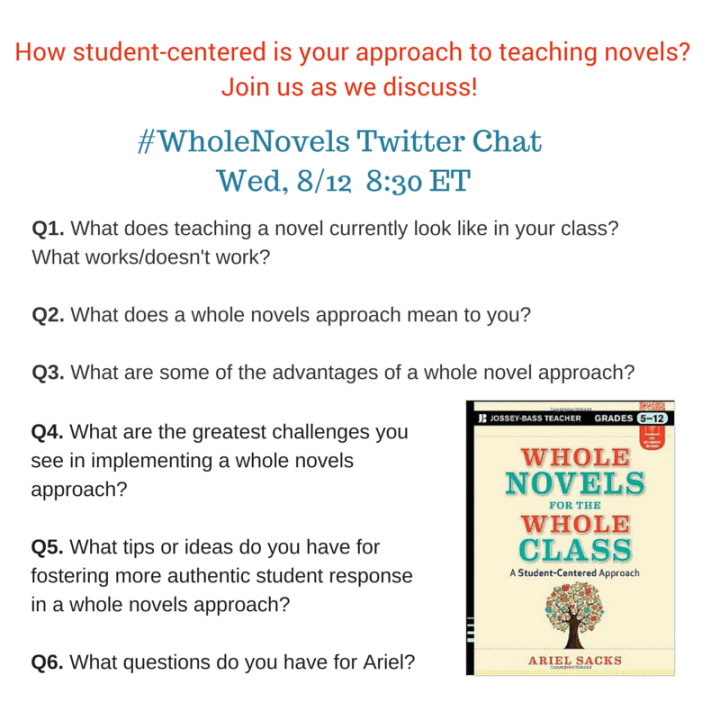
 It’s almost time! Please join us for a Twitter chat with author and educator Ariel Sacks as we discuss a more student-centered approach to teaching novels. Read More
On Venn diagrams: What does reading look like in the real-world?
 Kylene Beers posted this on her Facebook page this afternoon:
When I finish reading a book, I want to think about it and talk about it, and then I want to start reading my next book. Never have I closed the covers, sighed, and said to myself, “Now, now I want to make a Venn Diagram.”

Three things for the first 48 hours
Glance at almost any education focused website, blog, or Twitter feed in mid-August and you’ll find no shortage of first-day-of-school activities. In one of my education-related Facebook groups, someone recently asked for suggestions on how to spend the first day in class. Others asked about how much time to spend on community building activities versus how soon to jump into the curriculum. Not surprisingly, opinions varied, as they should.
As for me, I’ve spent less time reviewing the syllabus each year and more time on doing things that will get us reading, writing, and talking more quickly. My goals for the first two few days of school, then, include the following:
- Give students a general overview of the course
- Set up the classroom environment
- Learn about student preferences and interests
Getting out of the way, part 2.
 “So, you’ve been busy.”
And so began a conversation with Judy, one of my writing project friends and mentors. We were meeting over coffee to discuss our thoughts on the third edition of Atwell’s In the Middle. In April, I had shared with Judy how I had started reading the book and wanted to pick her brain about her approach to reading and writing in her classroom. I had been feeling some sort of shift happening in my thinking and teaching, but I needed someone to talk to―someone whose voice could bring some clarity. And so I was most grateful to Judy for taking the time to sit with me on a warm summer day in August to talk Atwell over coffee.
By “busy,” Judy was referring to my recent reading-writing-thinking around several professional texts, much of which is recorded here in blog posts. Seeing my head spinning with ideas, Judy gently reminded me to pace myself. “Try a few things this year,” she said, “see how it goes. You can always add more things the following year.”
She’s right, of course. Deep breaths, I tell myself. Read More

Favorite Goodreads: 2015 Student Edition
In the midst of my classroom prep this week, I came across the binder of letter-essays that my 9th graders wrote at the end of the year. In this binder are 75+ letters that described their favorite independent reading selections. As I paged through their letters again, I couldn’t help smile at the way my students wrote about their favorite titles with such enthusiasm, even tenderness. Kylene Beers and Robert Probst remind us that close reading is the distance between the text and the reader. What was clear in these letter-essays was exactly that closeness―an intimacy that comes from a deeply felt experience. I cannot wait to share their letters with my students this coming year.
As for the titles themselves (above) . . . there was an interesting mix of expected and unexpected favorites. Read More
Getting Out of the Way
Today I finished reading yet another pedagogy book, this time Whole Novels for the Whole Class by Ariel Sacks, an educator and English teacher in New York. Over the last ten years, Sacks and her colleagues have developed an approach to teaching novels with their students that prioritizes and protects the student’s personal reading experience. Instead of breaking down novels into assigned pages per night, with discussions on that reading the following day, she advocates for allowing students to read the entire novel first before formally discussing it. In her words:
In the whole novels program, we honor the nature of the literary art by having students look at the whole work, not breaking the experience down into little pieces. Through the work, we create an intellectual community that is socially relevant for students and gives them opportunities to build the critical-thinking skills, creativity, and habits of mind they need in the twenty-first century. (19)
To be honest, I was skeptical. I have almost always given students reading schedules, with assigned pages per night, which we discuss the next day. Exactly the approach that Sacks argues against. Based on the reading my students do the previous night, the next day we review the material and focus on a particular element from that reading. For example, at the start of a book, our first day of discussion is usually focused on who the protagonist is. I hand out charts, diagrams, and other graphic organizers to help students. We take notes. I check for understanding. Students respond, ask questions. Then we repeat the next day, and so on. Discussion can be lively and animated. We debate, we laugh, we wonder. Students are engaged. What was wrong with this system? Why would I want to change it? It’s not broken, is it?
As if reading my mind, by the time I turned just a few pages, Sacks provided some thought-provoking reasons. Read More
Notice & Note, then Write: Quickwrites
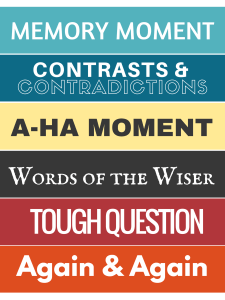 * This is Part 3 in a series on how to use the signposts from Kylene Beers and Robert Probst’s Notice and Note to inspire student writing. Here are parts 1 and 2.
In Notice and Note, Beers and Probst make this important observation:
As you think about each of these signposts, you’ll see that they appear not only in texts but also in our lives. When your significant other mentions again and again that the garbage needs to go out, there’s a subtext to that message—and it has to do with rising anger! When the friend who always checks on you suddenly begins to ignore you, then the contrast with what expect, the contradiction of an established pattern, makes you wonder what is wrong. If you’re now a parent, you can look back on those long talks with your own parents not as “another boring lecture” but as your parent’s attempt to spare you some pain, to impart words of someone wiser. When a friend asks you what your teen thought of the party that weekend, you suddenly realize—aha—that your teen’s sad face over the weekend tells you she hadn’t been invited. (74)
As Beers and Probst point out, the reason that the signposts are so ubiquitous in the texts we read is because they are ubiquitous in our lives. After all, art imitates life.
So how do we get students to see this? Read More

Worth the time.
I ‘ve decided that since I seem completely incapable of turning my teacher brain off this summer, I’m going to embrace it. As such, I’ve been doing a lot of professional reading—reading new-to-me titles like Reading Ladders, In the Middle (3rd ed.), Thrive, Worth Writing About, and Whole Novels for the Whole Class, as well as rereading well-loved titles like Deeper Reading, Write Like This, Notice and Note, and Book Love, among others. (Yes, I understand this is a crazy list.)
This open exchange of ideas—sharing, brainstorming, problem-solving—has reminded me of how important it is to have a rich network of support.
It’s been an energizing experience. Every time I turn a page, I find another idea I want to try out. My notebook is filled with all sorts of notes and reminders for next year. Read More
Slice of Life: To Minivan or Not to Minivan
 So it finally happened.
We bought a minivan.
The fact that we bought a minivan seemed to evoke (provoke?) plenty of discussion among our friends and family. As we waited at the dealership for the paperwork to be finalized, I posted a picture to Facebook with the caption “It’s finally happening. Now.” The reactions were swift, with most people falling firmly in one of two camps—Yay, you bought a minivan! or Noooo! Don’t do it! You can’t buy a minivan!
The happy minivan owners couldn’t stop raving about life with their swagger vans. “Drove to Savannah, GA and Portland, ME in last few months with kids in Odyssey. It’s a no brainer!” wrote one friend, while several others gushed, “We LOVE our Odyssey!!!”—capital letters and exclamation points included (and there were often many).
I’ve never been anti-minivan, and honestly, I’ve always wondered why some people hold such animosity towards them. Read More
On the Need for Peer Response
I recently had the opportunity to present at Strategies for Writing, a PA Writing/Literature course. One of my writing institute colleagues was teaching the course and asked me to come in to present on using peer response groups in the classroom (she knew that I had done research and work on this topic).
I was thankful for the opportunity to revisit a lot of the thinking and planning I had done regarding peer response groups. Putting my presentation together and talking with other teachers reminded me of many reasons why peer response groups are so valuable in the classroom. Simply put, students need more authentic feedback on their writing than any single person―me―can give them. If we teach and trust our students with peer response, wonders can happen. (You can view my presentation and materials here.)
In no particular order, some thoughts, takeaways, truths: Read More
 Tricia Ebarvia
You must be logged in to post a comment.