Presented at the Summer Invitational Writing Institute at the Pennsylvania Writing and Literature Project, West Chester University. July 2015. Read More

Presented at the Summer Invitational Writing Institute at the Pennsylvania Writing and Literature Project, West Chester University. July 2015. Read More

Three years ago, my first attempt at a classroom library was a collection of titles that I’d read during and after college. Well-loved copies of books like A Farewell to Arms, Pride and Prejudice, and Mrs. Dalloway sat along side more contemporary fiction I read for pleasure when I had the time, titles like A Thousand Splendid Suns and The Time Traveler’s Wife. As an English major and general book nerd, it was a lot of books! That was also the year I was teaching AP Lit, so many of those “English major” titles were going to come in handy with the independent reading I was planning on having my seniors do.
But I soon realized that while many of these titles were great for AP Lit students, they weren’t so great for my other classes, especially my ninth graders. I suspected that some, if not several, students were Spark-noting and Schmooping through their independent reading. As one student admitted in a reflection on her middle school reading, “I picked a book I didn’t know anything about, read a little of the first part, and then Sparknoted the rest to do a project.” Here’s another student: “Given a choice between reading and helping my mom clean the house,” another student once said, “I’d rather clean the house.”
The more I thought about it—and the more I read the work of Nancie Atwell, Penny Kittle, Kelly Gallagher, Donalyn Miller, and others—the more I realized how important it was to surround students with titles that would speak to them.
So my challenge was clear: how could I build a classroom library that could inspire an independent reading life?
Continue reading at WRITE . SHARE . CONNECT, the PA Writing and Literature Project Blog.
As the culminating project for their 9th grade year, my students created an infographic to represent their year in reading. They included the 9 books they read as part of the course (our “whole class” novels) and then any additional books they completed as part of our independent reading endeavors. I’m so incredibly proud of the reading they accomplished, and I think the highlights in the gallery below speak for themselves: Read More
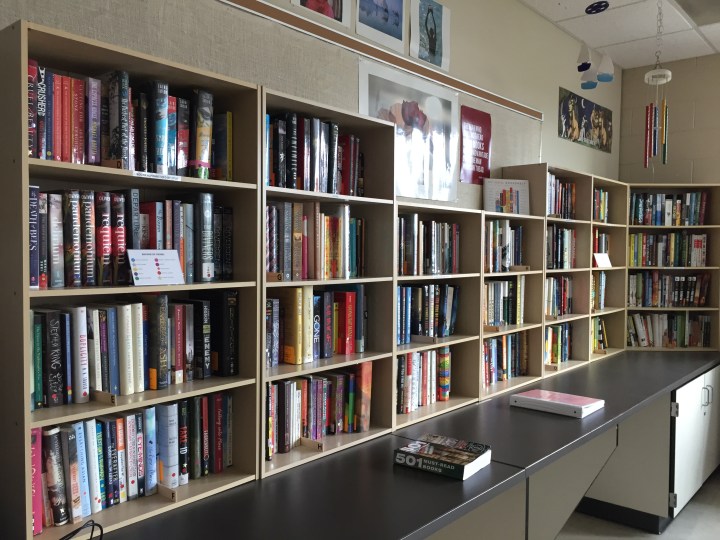
First, let me say that our school library is wonderful. Thanks to the efforts of our talented librarians, our school library is filled with many high-interest, engaging titles. I take my classes to the library regularly to give students the opportunity to hear book talks and to browse through the library’s collections.
Still, I felt like I was hitting a wall when it came to independent reading. It’s one thing to take time to visit the library to seek books and another thing to simply be surrounded by books every time you walked into your English class. And that’s what I wanted my classroom to be—a place where students were surrounded, literally, by books. Consistently. Every day. I wanted a place where reading was “top of mind” in a way that it wasn’t before.
And by the end of the school year, my classroom finally became that place. How?
Continue reading at WRITE . SHARE . CONNECT, the PA Writing and Literature Project Blog.

Presented at Tredyffrin-Easttown School District Language Arts Standing Committee, May 2015 Read More
The other day I announced to my ninth graders that we were about to begin our very last book of the school year, The Kite Runner by Khaled Hosseini. Some students were, no doubt, excited about the arrival of summer. Others expressed surprise at how quickly the year had gone by.
The end of the school year always brings mixed feelings for me. There’s relief, to be sure, in knowing that the proverbial light at the end of tunnel is near. There’s also some sadness in saying goodbye to students I’ll miss the following year. But there’s always some regret, too, in thinking about all the things that either went wrong or didn’t get done. “I wish I’d done more of X,” I say to myself, or “I wish I spent more time on Y” or “Why didn’t I do Z? I should have done Z!!!”
A chance to tweak where needed, find a better way, and sometimes, when something more daring is called for, start over again and try something new.
In the short term, regret can weigh on us, and weigh heavily. But in the long term, regret also has the power to lift us up. In Medusa and the Snail, scientist and essayist Lewis Thomas reminds us that “what is needed, for progress to be made, is the move based on the error.” I know I make my share of mistakes in any given school year. But the wonderful thing about teaching is that every “end of the school” year ushers in the beginning of the next. They say you don’t get many second chances in life, but in teaching, each school year is a second chance. A chance to tweak where needed, find a better way, and sometimes, when something more daring is called for, start over again and try something new.
The key, I’ve realized, is to find time to reflect, even amidst the chaos and busyness of the 4th marking period and final exams. But reflection is what fuels us for the following year. Reflection is what fortifies us for our second chance. Below are just a few ways that I’ve been able to not just take time to reflect, but to also act on that reflection:
Every year as April approaches, my colleagues and I gather together to make a decision. What poem will we choose to celebrate National Poetry Month this year?
For the last nine years, students at Conestoga High School have marked National Poetry Month with a celebration known as “One Poem, One ‘Stoga.” Each April, every English class takes a break from its regularly scheduled programming to study one poem together. That means that more than 2,000 students, from 14-year-old freshmen to 18-year-old seniors, read the same poem. It’s one of the few shared experiences students have that transcends age, grade, and academic level.
As you can see, we’ve celebrated National Poetry Month with a range of wonderful poems:
While reading such beautiful poetry is certainly worthwhile on its own, each year students also use the selected poem as a mentor text to write their own poetry. Over the years, we’ve had poems that explored thirteen ways of looking at sunsets as well as the fury of the backpack. One of the few poems I’ve written that I’ve actually liked—I openly admit to being poetry-challenged—was inspired by Li-Young Lee’s “The Weight of Sweetness.” My version, about the weight of motherhood, is below:
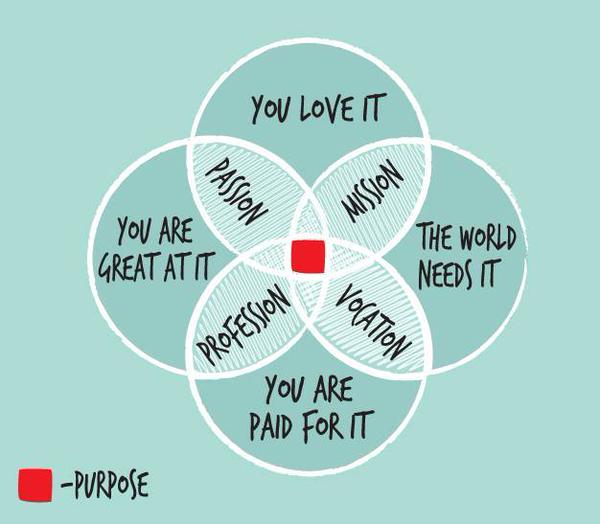
I came across this infographic in one of my social media feeds the other day and immediately saved it. I tried to locate the original source by doing a reverse image Google search, but it looks like the image has been copied/pasted around so much on the great and wonderful world wide web that locating the source is beyond my Googling prowess. So if, by some small chance, the creator is reading this, thank you.
The infographic got me thinking about Purpose with a capital P. And it reminded me of a question I ask students, the same question to bookend the school year.
Ask me anything.
 About a year and half ago, I was presenting at the PA Writing and Literature Project (PAWLP) fall conference on technology. At the end of the conference, one of the co-directors, Judy Jester, asked me to help her and others “tweet” for the project. “I actually don’t use Twitter,” I told her. I think she was surprised. I’d just given a presentation on blogging with my students, and I was fairly active on most social media sites… that is, except for Twitter. Read More
 I’m in the middle of (the awesome) Kelly Gallagher’s new book, In the Best Interest of Students. In it, Gallagher takes on the Common Core anchor standards and looks carefully at what works and what doesn’t work. I just finished the section on best practices in reading, and as I expected, every page has given me something to think about, whether it’s a specific instructional strategy or general question about pedagogy. It’s overwhelming in all the best ways. 🙂
A few takeaways so far from Chapter 2, in which Gallagher points out where the CC anchor standards are particularly strong: Read More
 Tricia Ebarvia
You must be logged in to post a comment.