My GoodReads: Fall 2014

Now that the first marking period is officially behind us, my ninth graders and I are now fully immersed in our independent reading endeavors. As of the first week of November, my 80+ freshman have read more than 225 books, with titles ranging from the hot Maze Runner series to other popular YA titles like Thirteen Reasons Why.

Screen Shot 2014-11-13 at 9.45.22 PM

Wordle of the most popular titles that my 9th graders have read so far this year.

I’ve tried, as much as I can, to keep up with my students and read along side them. Young people can never have enough models for reading, as I was reminded time and again at the NCTE conference last weekend. And if reading along side my students means that I get to read—and as a former English major and self-professed book nerd—I welcome the opportunity to spend time with as many good books and interesting characters as I can.

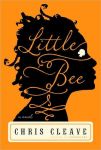
In no particular order, here are the books I’ve read this past fall:


While I enjoyed them all, I have to say that among my favorites was Emily Murdoch’s If You Find MeA PA Young Readers Choice nominee this year, the novel tells the story of fifteen-year-old Carey and her younger sister Jessa, who were abducted by their mother and taken to the woods where they lived for years, with virtually no contact with the outside world. While the narrative itself was engaging, for me, the voice was what I found most compelling in this novel.

With the very notable exception of the Harry Potter series, I’m not much of a fantasy fan. But Leigh Bardugo’s Shadow and Bone was magical. The story of two orphans, one of whom denies her destiny as one of greatest Grishas of her time (in Bardugo’s world, a Grisha is a person with special supernatural abilities), Shadow and Bone had the power to transport me to another place. It’s also the first in a trilogy, so I’m looking forward to stepping back into the world Bardugo has created.

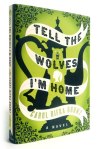
tell the wolvesEvery once in a while, a book will not only surprise me, but just take my breath away. As much as I’ve enjoyed all the books I’ve read recently, Tell the Wolves I’m Home by Carol Rifka Brunt stands heads and shoulders above the rest. A fellow teacher and friend recommended the book to me last weekend, and although I knew nothing about the novel (I hadn’t even heard of it), his recommendation was so glowing that I couldn’t resist.

And I’m so glad that I didn’t.

Beautifully written, Tell the Wolves I’m Home tells the story of 14-year-old June Elbus just after her favorite uncle—and best friend—passes away from AIDS. It’s 1987, so the AIDS scare can’t help be an important part of the context of this coming-of-age story. That said, the story is very much centered on June, her grief over the loss of her uncle, and her tumultuous relationships with her older sister Greta and their “absent” parents. I can’t remember the last time I read a novel that got the voice of its protagonist so right. It’s one of those books you put down and can’t believe that the characters aren’t real.

I was overwhelmed by this book… and in the best possible way… the way that sometimes only the best literary experiences can move us.
#EnglishTeacherNerdsUnite

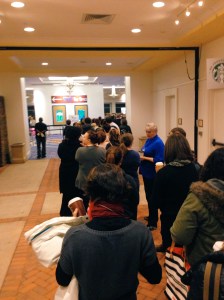
NCTE Exhibition HallIf you look at the picture on the right, you might be asking yourself why all those people are in line. Concert tickets? The latest gadget? Maybe a Kleinfeld’s sample sale?
Nope.

What you’re seeing is a line of hundreds of language arts and English teachers—from pre-service to elementary, from middle to high school to college—waiting for the NCTE exhibition hall to open on Sunday morning. So while others slept in, these teachers were anxiously awaiting for the doors to open. What’s behind these doors? Well, books, of course. As I said to my students on Monday morning, it was like a Black Friday sale for teachers. Needless to say, they were a bit incredulous.

During the NCTE Convention exhibition, dozens of publishers offer discounts on books for classroom use. On the last day in particular, hundreds of books are even given away for free, as publishers promote upcoming titles. One elementary school teacher I spoke to said she was walking away with 25-30 books to add to her classroom library. I saw several teachers with rolling luggages filled with books. And lines for authors signings zigzagged around the exhibition hall.

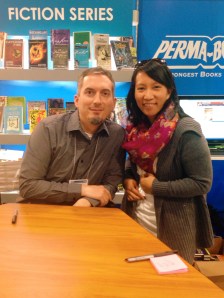
James DashnerSpeaking of authors, another highlight for me, personally, was the opportunity to meet several authors. For example, here I am with James Dashner, author of the Maze Runner series. He was signing at the PermaBound booth. As I walked by, I was surprised to see his line was relatively short. After joining the back of the line, however, the PermaBound rep let me know that they had run out of books for the signing. No matter. I asked if I could just get my picture taken with him to show my students (Look, authors are real people, too!). 🙂

Although I was in workshop sessions for most of the weekend (more on that in another post), I did get to carve out some time with a few more authors.

Despite being mobbed by hundreds of crazy English teachers (we’re a special breed, I must say), each author was incredibly gracious. I asked David Levithan the question that’s been on my mind (and on many of my students’ minds) ever since I finished Every Day: will there be a sequel?  The answer? Thankfully, yes. A companion novel to Every Day is coming out next year. Now there’s just the wait. But at least I’ve got a pile of books to read to keep me busy until then.


There’s a movie? Let me read that book.

Gayle Forman’s YA novel If I Stay has been sitting on my bookshelf for months, maybe even a year (it’s part of a continuously growing stack of books on my “to read” shelf; I admit, I have a sickness). The book reviews were generally good, and it was on NPR’s best books for teens. So I purchased it, along with a dozen of other YA books, to add to my classroom library.

But I didn’t actually read the book until this past week. So why now?

Because I saw the movie trailer.


I didn’t read it because of the trailer itself (which seems interesting enough, though not extraordinary). The fact there’s a movie, period, is enough to get me interested. After all, someone clearly found the story compelling enough to go to the trouble. And if someone in Hollywood was interested, then the book has to be pretty good, right?

But there’s a flaw in this logic.

Just because a book is “good enough” to be made into a movie doesn’t actually mean it’s a good book.

What works in film doesn’t necessarily work on paper and vice versa. For example, take the Twilight series. I tried to read the books. Several years ago, when the first Twilight movie was about to be released and my students debated Team Edward or Team Jacob, I wanted to find out what the fuss was all about. I got to about page 35 and had to put the book down. I couldn’t get passed what was (in my opinion) a stilted and awkward writing style.

(But the movies? I’ve seen all four. And I’m only a little bit ashamed to admit I enjoyed them.)

The same thing happened with the Divergent series. Many of my students were reading it, and yes, I saw the fancy “soon to be a major motion picture” sticker on the cover. So I tried it. I got to about page 75 with that one and put it down. The issue? Like the Twilight novels, the style. I just couldn’t get into the narrative.

That said, I have to admit that I often decide to read novels if I know there’s a movie version coming out.

In fact, I read the entire Hunger Games series the same week that the first movie was released. I’d already been interested in the books since many of my students raved about them, but it wasn’t until the movies came out and you couldn’t get through a school day without hearing kids debating Team Gale or Team Peeta (Team Peeta, of course!) that I finally decided to enter District 12.

So maybe it’s not because some Hollywood director liked a book that makes me interested in reading it. Maybe it’s the buzz that a movie generates. The act of reading is a deeply personal, solitary activity. But as anyone who’s read a good book knows, the first thing you want to do when you finish reading is to talk about it: argue about a character’s decisions, gush over your favorite parts, and of course, debate the ending. Movies add an extra layer to that discussion, because now you’re not just talking about the book, you’re talking about the book in relationship to the movie—were the characters as you expected? what was different in the movie? did the director get it right?

It’s that discussion that is often one of the most animated among my students. I had a class last year that, at the slightest mention of Percy Jackson, could not hold down their anger at how different the films were from the books. In short, they loved the books, thought the movies were terrible, and could launch into a tirade cataloguing all the reasons why.

But no matter how the film adaptations turn out, here’s the thing about them: they get people to read.

When the Hunger Games movies were released, the books saw a sharp 55% increase in sales as compared to their original publication. When the Great Gatsby trailer premiered—a full year before the actual movie was released—according to Publishers Weekly, the book jumped to #27 on Amazon’s bestsellers list, a 66% increase.  In the days leading up to the May 2013 release, the book spent time at the #1 spot on Amazon’s list, and by the end of the year, it was one of the top selling books of 2013 (not bad for a book almost 90 years old!). In that same year, other books such as Ender’s Game by Orson Scott Card and The Book Thief by Marcus Zusak, also enjoyed the “book to movie” bounce. With the success of Marvel Studios filmseven comic books have enjoyed renewed interest and resulting sales.

It’s a paradox, but movies can get people to read. I know this is true of me, and it’s certainly true of my students. Young adult fiction sales have been increasing at the same time that more young adult novels are being turned into movies. Walk into any Barnes and Noble and you’ll find a table themed, “At the Movies” or “From Book to Screen,” covered in books with movie adaptations like The Fault in Our StarsThe Maze Runner, and Divergent.

the-giverSo while it may not be the best way to decide what to read, choosing a book because “there’s a movie” has led me to some surprisingly enjoyable reads. And If I Stay was definitely one of them. In fact, I enjoyed the novel enough that I immediately hopped on over to Barnes and Noble to pick up its sequel. While I was there, I couldn’t help glance over at the “At the movies” display table to see what was coming-soon-to-a-theater-near-me. That’s when I decided to finally pick up a copy of The Giver, a classic I’ve always wanted to read but never have. . . . yet.

I finished The Giver and Forman’s If I Stay duet in just three days.  Three great reads I may have never experienced had it not been for Hollywood.


And if you’re like me and would like to follow the book-to-movie-trend, Common Sense Media has a great list of books coming soon to a theater near you.

A Visual Syllabus

One of the first documents I revisit at the start of any school year is the syllabus. After all, it’s the first thing I hand out to students. The syllabus provides students with their first overview of what they’ll be learning in the upcoming year. It’s the “first impression” they have of the class and, by extension, of me.

Each year, I update my syllabus to reflect changes in the curriculum. But aside from swapping out a book title and changing the dates, the syllabus usually stays the same. Recently, however, I came across an interesting idea on Dr. Curtis Newbold’s blog, The Visual Communication Guy. In a post titled “Would a Course Syllabus be Better as an Infographic?”, Newbold shared his experience changing his syllabus from a traditional text into an infographic. He received an overwhelmingly positive response from his students and colleagues.

I decided to try it out for myself and spent some time updating the course syllabus for my AP Lang class. I used ease.ly to create the infogaphic. When I was finished the design process, I could then download the infographic as a PDF as well as JPEG file.

So here’s what my syllabus looked like before:

AP Lang traditional syllabus combined

And here’s the infographic version I created last week:

APLangSyllabus 1

 Just looking at these two documents, it’s not hard to see how the infographic version is much more attractive of the two. If I were a student, I know which course I’d rather take, and honestly, as a teacher, I know which course I’d rather teach!

So what did I learned from this exercise?

For one thing, moving to a visual syllabus meant that I had to cut down on text. . . and cut down substantially. My original syllabus was two pages long. I made a decision that when I made the infographic version that I would limit myself to a single page. Because I had this limit, I was forced to really think about every piece of content I wanted to include and decide whether or not it was really necessary. What was essential information and what was nice-to-know-but-not-necessary?

Doing this also forced me to think about my audience—my students—in a way I hadn’t before. In deciding what information was essential, I had to put myself in my students’ shoes and think about what they needed to know. My previous syllabus had all the information my students needed, but they didn’t necessarily need all of it. Then I had to frame the information in such a way, using words and pictures, that they could best understand it.

Finally, creating a visual syllabus made me rethink the course itself. What is the course ultimately about? How can I convey this information using pictures and other visual elements such as font and color? How can I then arrange the information so that it’s both attractive and easy to read? In thinking about these issues, I wasn’t just writing a syllabus, I was designing one.

Applications / Implications:

  • In what ways can other information be revised to be more visually appealing and interesting?
  • What opportunities can I give students to not just gather information, but to also design it?

On a related note, Newbold has another great post titled “10 Lame Documents that Would Be Better as Infographics” about . . . well, you can probably guess. 🙂

#MyVisualYear

I have drawn a map. It’s one of the first things I did. 

– J. K. Rowling


One of my new (school) year resolutions is to try to tap into the power of visual art. As a hobbyist photographer, I know first-hand the power of the image and its ability to convey emotion, truth, and wonder, sometimes in ways that the printed word cannot.

A single picture or image, if well-chosen, can often times communicate an idea more succinctly than words. Words and pictures, in tandem, can be powerful tools. Austin Kleon’s book Steal Like An Artist is just one of many example of this new type of “hybrid” communication.  Here, for example, is one of my favorite pages from his book:

steal-like-an-artist-austin-kleon-5

Kleon could have written hundreds of words to describe the gap between where we are now and dreams we strive for. But the simple image above is powerful because it tells us everything we need to know with relatively few words: that the gap can be wide, that it will take hard work—and some creativity—to make it across, and that it may require a certain amount of risk to make that critical leap if we want to achieve our dreams.

My interest in Kleon’s work led me to other visual artists, including the work of Dan Roam, whose “show and tell” premise is simple, but powerful:

Screen Shot 2014-08-07 at 1.01.25 PM

Anyone who has watched a TED Talk knows that this is the basic formula for many, if not most, of them. And although I’m clearly not on the same stage as Sir Ken Robinson, Elizabeth Gilbert, or Daniel Pink, I “present” material every day to my students. Why not integrate even a little bit of these three steps into my teaching?

As an English teacher, I think I’ve got a handle on numbers 1 and 2. After all, isn’t telling the truth through story exactly what great literature does?  Alas, my actual drawing skills leave much to be desired.

The thing is, I used to love to draw when I was younger. In fact, I carried a sketchbook around with me throughout high school even though I never actually took an art class. Because I “thought” I was going to be a doctor one day, I doubled-up on science classes in high school, leaving no other room in my schedule for electives. It’s a decision I still regret, and perhaps one reason I find myself enrolling my sons in extra art classes during the summer.

But visual notetaking has tremendous potential. After all, we process so much information visually.

Screen Shot 2014-08-07 at 4.16.53 PM

Here, and below are two excerpts from a great infographic, “Why We Crave Infographics” – very meta!

We also remember information much better when we engage our visual and kinesthetic senses into our processing. Drawing, after all, is kinesthetic as well as visual.

Screen Shot 2014-08-07 at 4.28.18 PM

But like I’ve said before, my drawing skills are definitely lacking. And I imagine that while there are plenty of students who are naturally gifted artists and visual thinkers, many more may feel the same nervousness I feel when asked to draw.

But there’s just so much upside to learning how to integrate writing and drawing. I became even more convinced of the potential for visual note-taking after seeing this TED Talk earlier this year.


As the speaker, Rachel Smith, points out, visual note-taking “is not about drawing. It’s not about making beautiful pictures. It’s not about making detailed images. It’s not about accurately drawing a person or a car or a lightbulb. It’s not even about doing something that’s recognizable to anybody other than yourself.” She continues,

The thing you need to do with visual note-taking is capture what you’re hearing in a way that’s memorable for you.

Smith goes on to outline three simple steps for getting started: 1) pick a took, 2) develop a few basic icons, and 3) listen for and capture key points. After that, it’s all practice.

In my experience, the only way to conquer a fear is to face it head-on. So this year, I’ll be drawing alongside my students. I’ve already started practicing some techniques and have even ordered Michael Rohde’s The Sketchnote Handbook.  He has some amazing examples of sketchnotes produced from his book on his website, sketchnotearmy.com. Looking at these sketchnotes, it’s easy to imagine how engaging this process could be for students, and of course, for me, too. 🙂

My first feeble attempts at sketchnotes.


New (school)Year’s Resolutions

Each August brings with it mixed feelings.

The first is always shock: Wow, August already? Didn’t we just get out of school?

The second is denial: August? Really? It can’t be. Didn’t we just get of school?

Then anger: What, August?!? Why?!? We just got out of school!!

Eventually and slowly comes acceptance: August? Okay, deep breath, and here we go. For some teachers, this can happen in mid-August; those are the teachers who can be found coming to school early to get their classrooms set up.  For other teachers, acceptance may not happen until sometime during the first inservice day when they look around and realize: Wow, I guess this is really happening.

August always comes too quickly for me, mostly because I tend to have a huge to-do list for the summer that never gets done. This summer, for example, I was supposed to paint the downstairs powder room and renovate the boys’ bedroom. I got as far as picking out a few paint swatches from Lowe’s and taping them to the wall. (Somehow I still overestimate how much I can accomplish while watching/entertaining/feeding/herding my three boys.)

14592097710_c96c60cff7_z

These guys keep me pretty busy in the summer (and year round)!

But now that it’s officially August, thoughts of back-to-school take center stage again and nervous excitement builds as I get closer to that first day. I love the beginning of the school year—the energy, the optimism. While January may be the time that the rest of the world makes their resolutions, for teachers, September is our new year, our time to begin anew, to set goals, be inspired. I suspect some students feel the same way, too.

Sometimes students ask if I get bored teaching the same thing over and over again. And my answer is always no, of course not! First, my students are different every year, so even if the material is the same, it’s the unique interaction between students and the material that makes each year special. And second, every year, I make it a point to try something new. Sometimes that means piloting a new book—such as when I introduced The Kite Runner two years ago. Or a new project—like the This American Life project my colleague Ben Smith and I did with our juniors last year.

So what will this year bring? A few of my goals:

For all my students:

  • Integrate more visual art—paintings, sketches, photography—into my writing instruction.
  • Create a system of visual note-taking or sketchnotes in my own notebook and teach students how to do the same.
  • Redesign various parts of my current instruction to reflect a more “Creativity Workshop” approach, including more opportunities for creative writing and for students to develop/express their voice

For my ninth graders:

  • Implement a more comprehensive reader’s/writer’s notebook approach with my ninth graders
  • Establish clearer goals and more structure to the independent reading program
  • Find a place to include more Asian literature in our world literature course

For my juniors:

  • Teach rhetorical analysis writing more explicitly, with a focus on pre-20th-century texts
  • Explore some flipped learning opportunities with writing mini-lessons

Of course, looking at this list already feels overwhelming! But it’s a good kind of overwhelming. The truth is that teaching can be an incredibly frustrating job. Increasingly, teachers are being tasked to do more with less: fewer resources and less time. That’s why setting personal teaching goals have been so valuable for me: they provide a sense of autonomy and a little “light at the end of the tunnel” even when there are outside forces tugging in other directions.

View from my ballroom

One of the things I love about teaching is the creativity: creating new assignments, finding more effective ways to engage students, and designing materials that are more inviting.  Thinking like a teacher doesn’t end with the school day, and I find myself planning lessons everywhere I am, whether it’s in the kitchen when I’m cooking dinner or in the car when I’m driving to work.  Teachers live and breathe in the world of ideas.

IMG_2360So when I heard that the AP conference was going to be held in Philadelphia this summer, I jumped at the opportunity to attend and to pick the brains of some of the leading AP teachers from around the country.  And so over the course of two days in July, I attended several workshops facilitated by some wonderful presenters. Workshop topics included:

  1. Developing Schema for Successful Rhetorical Analysis
  2. Entering the Conversation of Synthesis with Students
  3. Pictures that Bridge Gaps: The Photo Essay and the Synthesis Essay
  4. Learning to Decode—and Enjoy—Pre-2oth-Century Texts
  5. Making Connections: In-Depth Analysis of Full-Length Texts Using Learning Stations
  6. Novels as News, Poetry as Proof: Using Literary Sources as Evidence

Even though the conference was only two days, I walked away with so many great ideas for not just teaching AP Lang but any English class.  Some key takeaways:

  • Try to use more engaging and interesting “real world” mentor texts that students can rely on as they develop their own voice. I can’t expect students to know how to write without first seeing what the possibilities for writing are.
  • Create more explicit writing scaffolds for students as a way to improve their rhetorical analysis skills.  Writing is thinking, so helping students write more clearly through the use of scaffolds can also help them think more clearly about the text they’re analyzing.
  • Show the similarities between visual arguments and written arguments, using visual arguments to improve students’ ability to understand written texts. This would be especially helpful in teaching the rhetorical triangle.
  • Use strong characters in fiction to teach students about tone.  Even though the AP Lang course is focused primarily in non-fiction, it can be difficult for students to hear the tone in non-fiction texts, especially if most of the non-fiction they are accustomed to reading has been primarily expository or informational texts.  In the pre-20th-Century workshop I attended, the facilitator demonstrated a lesson on tone using Pride and Prejudice and Gatsby. It was wonderful! After all, who can’t hear the snobbery dripping from Tom Buchanan’s voice or the ironic and haughty lines in many of Austen’s characters? Revisiting excerpts from books students have read in earlier English classes would be a great starting point since they are already familiar with those texts.

IMG_2374

  • Find ways to integrate more literary texts into persuasive writing. The workshop facilitated by Renee Shea and Robin Aufses, two of the authors of our textbook, focused on how to use literature to advance arguments in persuasive essays. During the workshop, we read an editorial published in the NY Times as well as an essay in The Atlantic, both of which used literary texts as evidence in making an argument. Not only does this help students further their own arguments, integrating literary texts in this way also reminds students that great literature does the same thing that great non-fiction does: raise questions and make arguments about some our most pressing societal concerns.  Issues of social class raised in Austen and Fitzgerald are the same issues debated between pundits in the NY Times and Wall Street Journal.
  • Examine more pre-20th-century texts to give students additional practice reading these sometimes difficult texts.  The average score on rhetorical analysis prompt on this year’s AP Lang exam—a letter from Abigail Adams to her son—was only 3.64 out of 9, the lowest in the history of the exam (the previous low was 3.96).  One way to help students is more direct instruction in learning how to read the nuances in the grammatical structures in these texts.

While some of the ideas weren’t necessarily new, it was nice to see so many other teachers affirming some of the best practices I’ve used in my own teaching over the years. I also enjoyed seeing the ways in which tried-and-true strategies—like learning stations—could be reinvented for the AP course.

Because the school year is typically a busy—and yes, sometimes frantic—time, it can be hard to find the time to implement new ideas or revise lessons. But opportunities like attending this year’s AP conference, or going to NCTE conference a few years ago, are what rejuvenate my teaching spirit and hopefully will help keep me—and my students—engaged in the upcoming year.

Writing with an Artist’s Eye

Three years ago, I took a course called “Visualizing Words and Worlds” through the PA Writing & Literature Project (PAWLP) and this past July, I had an opportunity to co-teach the class for the second time at the James Michener Museum in Doylestown (a fantastic museum, by the way!).  The premise of the “Visualizing” course is simple: by integrating art and other visual activities into our instruction, we can help students become better writers and readers.

If you think about it, this makes sense. After all, we learned how to read by first looking at pictures, and when we teach younger students how to write, we often ask them to draw pictures next to their sentences. Too soon perhaps, we begin to rely on text only. Pictures disappear from books and doodles are relegated to the corners of notebooks when students are bored in class.

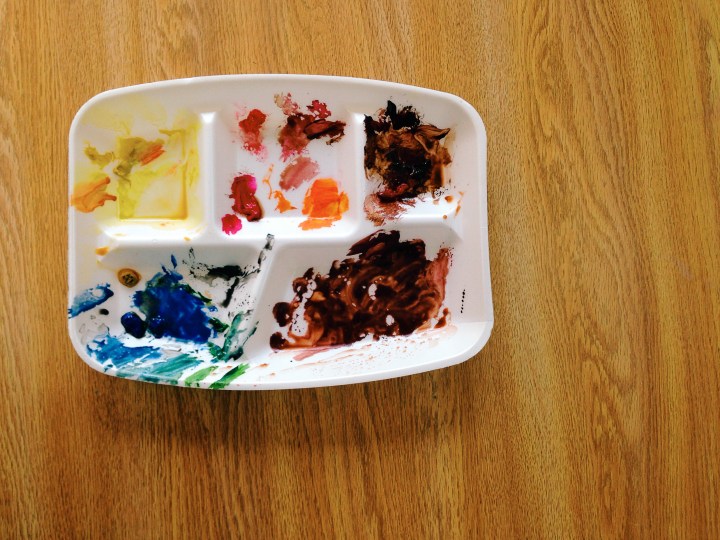
To get teachers thinking more deeply about art-reading-writing connections, every day during the course, a visiting artist comes in to teach, with each artist working in a specific medium.  We learned how to paint using watercolors, sketch a human face, make original prints, and finally, create our own found object sculpture. Although none of us were certified art teachers, the connections between art and reading and writing became more clear with each passing day.  An illustrator who draws a picture uses a variety of brushstrokes to achieve a specific effect. In the same way, a writer can “paint” a picture in the reader’s mind by using his own set of “brushstrokes”—a dramatically short sentence, a sentence fragment, a metaphor, a pun.

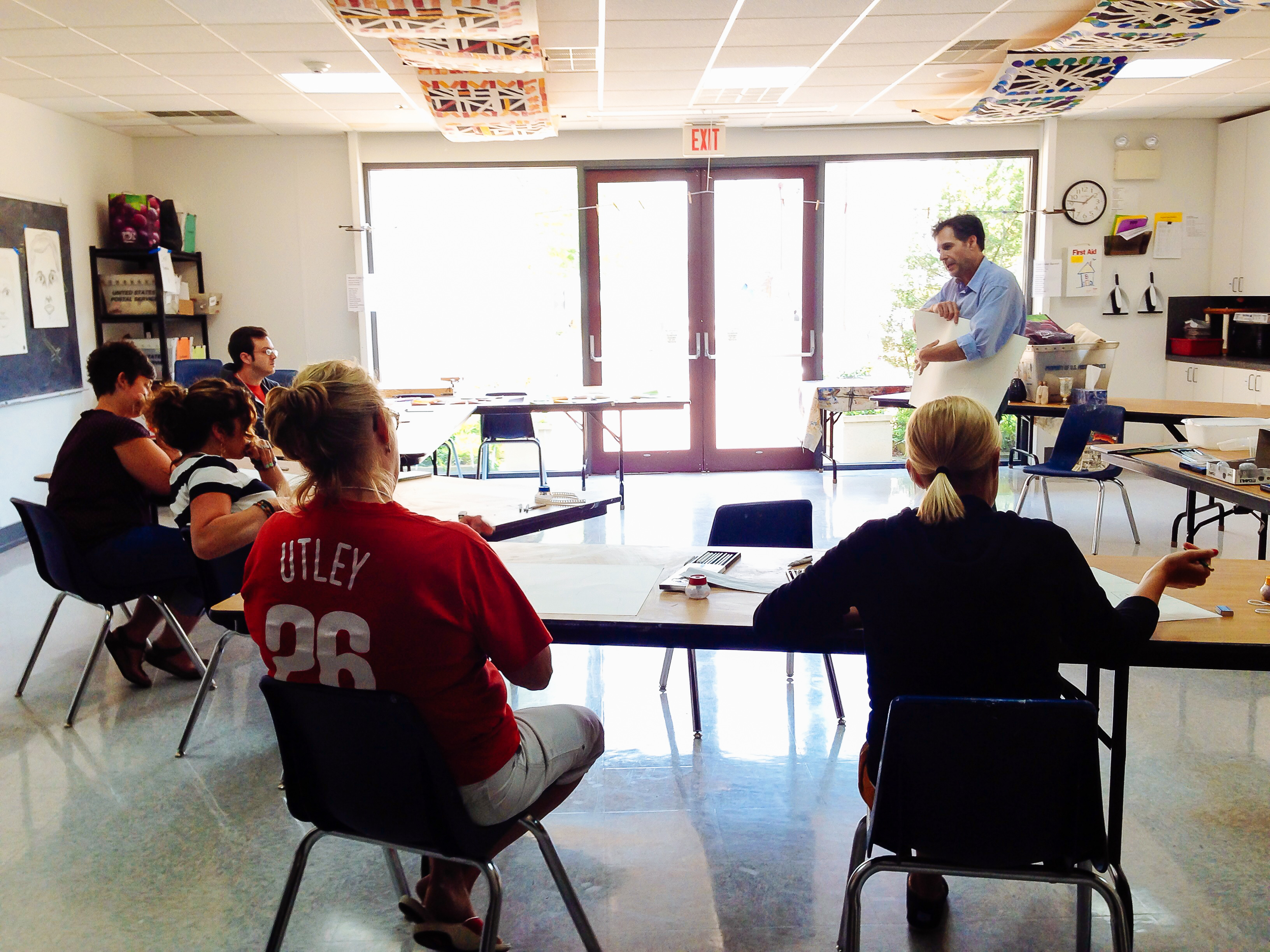
Children's book illustrator Peter Catalanotto's sketching workshop

Children’s book illustrator Peter Catalanotto’s sketching workshop

Even some of my best student writers struggle when I ask them to “show not tell.”  What does it mean to show?  Visual artists, however, are always “showing.”  The concrete details of their art—the choice of subject, the flurry of each brushstroke, the precise shades of color—work together for an intended effect.  When we think visually when we write, it’s easy to see how it’s the simple concrete details that can speak volumes.

In an essay for Now Write: Nonfiction, NPR contributor and teacher Christine Hemp writes:

William Carlos Williams dictum about things being the life of poetry holds true in creative nonfiction. . .  The essay teeming with “stuff” is much more memorable than one that floats in abstraction.  A piece about love doesn’t end up in our cells unless it is grounded in the softness of your lover’s neck as it disappears into the collar of his sweatshirt.  Or what about that scab you picked while you were crying on the phone to the man you knew would leave you by spring?  Just like the strong poem, the strong piece of prose is rife with metaphorical power—from your mother’s out-of-tune piano to the orphan sock that keeps showing up in your tangled underwear drawer.  When we turn to things, the truth comes at us through the back door, and we are surprised by ideas and emotions we didn’t know we possessed.

As Hemp points out, it’s the visuals that create meaning for us as readers.  And thinking visually means thinking—and writing—with an artist’s eye.

Printmaking workshop (with artist Jean Burdick)

Printmaking workshop (with artist Jean Burdick)

Taking and even teaching the “Visualizing” course also reminded me also of what it’s like to be on the other side of the classroom as a student.  You could measure my level of artistic ability with your pinky—that’s how talented I am!—and as such, being asked to sketch a human face on the first day of class is an intimidating experience.  But my nervousness with drawing is not unlike the trepidation many students feel with writing.  Working in the visual arts, as opposed to the language arts, forces me out of my comfort zone into a place where I have to take risks. And isn’t that what we want our students to do, too?

Finally, the course has inspired me to try taking integrating more visuals into my writer’s notebook as well.  Like I said, I’ve got pinky-sized artistic talent, so we’ll see where this goes…


To view more images from the course, click here


Special thanks to all the artists who gave their time to work with our teachers, and to Adrienne Romano, Director of Education, New Media, and Interpretive Initiatives at the Michener Museum, who is instrumental in making our course happen.

a summer, reading

It’s the middle of July and here I am, sitting by the pool, reading.  I know, not surprising for an English teacher, right?  But at least I’m outdoors in the sunshine while my kids can splash and swim.

I’ve been on a mystery and young adult literature run lately. In the last two & half weeks, I’ve read six books and currently working on a seventh. I’m definitely what you’d call a binge reader. I go long spells without reading anything (books, that is), and then binge on a dozen or so books to make up for it. I read a mix of genres to keep myself from getting bored or burned out by any one in particular.

So far, I’ve read a mix of mystery and young adult (YA) fiction. I purposely chose these two genres because they’re so immediately satisfying in terms of plot/story.  Mysteries keep me engaged and I’m always looking for YA books to recommend to my 9th graders especially. I know that it might disappoint some students (or even fellow English teachers) that I’m not at home delving into War and Peace or Anna Karenina, but after several months of doing in-depth analysis with my students, my brain needs a break.  I guess you could say that I sympathize with students who say they need something light to read for the summer. I get it. And typically the summer reading we usually assign is anything but light. So save that for August (that’s what I’m doing… saving my “more literary” reads for then).

This is my side table:

Day 184 summer reading

(Yes, that’s a first-generation Kindle on the top! I’m feeling very 21st century!) So far from that pile, I’ve read:

Down River by John Hart

Genre: mystery. I picked this up because it won the Edgar award for best mystery novel a few years ago. Plus, the premise sounded interesting: Young man found innocent of murder five years ago now returns home after receiving a mysterious phone call from a childhood friend. When he gets home, a series of attacks begin again and the townspeople, not surprisingly, connect the crimes back to him. Not necessarily the best writing, but the plot kept moving and the characters were interesting. 3.5 out of 5 stars.

Broken Harbor by Tana French

Genre: mystery/crime fiction. Broken Harbor is the fourth installment in French’s Dublin Murder Squad series. I first came across French’s work a few years ago when I noticed that her debut novel, In the Woods, won an Edgar Award. As you can guess, her novels take place in Dublin, Ireland, and I enjoy seeing a certain Irish style come through in her writing.  Each novel in the series follows a different member of the Dublin Murder squad, which makes it a little different than other mystery/crime writers who follow a single protagonist.  This was probably my second favorite among her novels, with The Likeness being my favorite.  In some ways, I felt like this particular book was the literary version of Law & Order (just the investigation, not the trial part). 4 out of 5 stars.

Eleanor and Park by Rainbow Rowell

eleanor and parkGenre: YA. I’m slightly ashamed to admit this, but… oh, how I loved this book.  My snobby, English-teacher self is yelling at me right now, but this book was such a wonderful surprise. Is it high, literary fiction? No. Is it somewhat cheesy and nostalgic? Yes.  But I don’t care.  Two “misfit” kids fall in love on the bus as they argue over comics and listen to the music of XTC, the Smiths, and U2. Did I mention that the novel takes place in the 1986? And since I grew in the 80s, this just makes the book that much more awesome.  I think I even liked this book better than that other beloved YA book Fault in Our Stars (I know, blasphemy, right?).  Dialogue was spot-on and the relationship that develops between the two characters was both sweet and realistic at the same time. Just loved. If you’ve read this, please let me know so we can ooh and aah about it (unless you didn’t like it, in which case, I don’t know you). 5 out 5 stars.

Thirteen Reasons Why by Jay Asher

Genre: YA. This book has been on my “to-read” shelf for a while now, and I’ve had several students read and love it.  The premise was compelling: protagonist Clay Jenson receives a mysterious set of tapes. As he listens to the first one, he recognizes the voice of Hannah Barker, a student at his school who committed suicide recently. Every side of each tape is dedicated to a person who was in some way responsible for Hannah’s suicide, and because Clay has received the tapes, it means that he is on one of them.  Like I said, very compelling premise and deals with some serious issues about teen suicide, bullying, gossip, etc.  Maybe it was because I read this immediately after Eleanor and Park, but I don’t think it was quite as good as I either expected it to be or wanted it to be.  While the narrative structure was interesting, the style itself wasn’t anything remarkable, which makes me appreciate YA writers like John Green, Rainbow Rowell, and Melina Marchetta that much more. Still, I realize I’m probably being nitpicky in my review, so overall, I would still highly recommend it. 4 out of 5 stars.

Ordinary Grace by William Kent

Genre: mystery. Reminded me of a grown-up version of To Kill a Mockingbird. I picked it up because it won the 2014 Edgar award (yes, there is clearly a pattern here) and I wanted another mystery to add to my summer reading list. It wasn’t the fast-paced, plot-driven novel I was expecting with the genre and that was a good (and wonderfully surprising) thing. It took a little while to get settled into the book and even though I could predict the ending about 2/3 of the way through, I enjoyed the novel and thought it was well-written. Some really beautiful lines, especially those regarding the nature of faith and forgiveness. 4 out of 5 stars.

To All the Boys I’ve Loved Before by Jenny Han

Genre: YA.  I wrote a little longer review on this book over on Goodreads.com. Click on over to read it if you like. While you’re there, feel free to “friend” me on Goodreads, too!  If haven’t heard of Goodreads, it’s basically a Facebook for book lover nerds where you create online bookshelves of the books you’ve read, share books, post reviews, see what your friends are reading, etc. Fun!  Oh, and I gave this book 3.5 out of 5 stars.


Right now, I’m about halfway through another Jay Asher YA book, The Future of Us.  In the novel, it’s 1996 and two friends, Emma and Josh, log into her computer for the first time to find their future Facebook profiles. Definitely an interesting idea: after all, if you could see your Facebook timeline 15 years from now, would you want to? And then if you discovered that you could do things today to change the future (and see those changes reflected on your FB page), what would you do? How much of your future would you want to know and how much would you try to change? I think I’ll move to some of my more “literary” books on my list, probably Chimamanda Adichie’s Americanah next (Adichie is also the author of Purple Hibiscus, which we read in world literature). After that, depending on how dense that read is, I may need something lighter. I guess we’ll see… and with a few more weeks of summer left, I’ve got lots of days by the pool to keep binge-reading. If you’re reading anything right now, I’d love to hear about it. 🙂 And in case you’re interested, here are the other titles on my “to-read” list this summer: