This weekend, I was browsing through my Feedly and came across Adam Grant’s current piece in the New York Times Sunday Review. I first discovered Grant’s work a few months ago when I was at school late browsing through the TED website, looking for a talk to show my students. Grant is a professor at Wharton, and recently published Originals: How Non-Conformists Move the World. His TED Talk—“The Surprising Habits of Original Thinkers”—brings up some interesting points about creative individuals. For example, original thinkers tend to procrastinate—which made me feel a lot better about my own procrastination habits. 🙂 Read More
Is School Becoming Irrelevant? (Part 2): How Our Beliefs Shape Our Practices
Beliefs are powerful. What we believe—about school, learning, learning in schools, and learning for the world—shapes every instructional decision made on behalf of students. For example, the belief that teachers need to be held accountable for student test scores is behind value-added teacher evaluation. The belief that all students can and should be learning the exact same material at the exact same time is behind standardized tests. And the belief in technology’s positive impact on learning is behind the decision to implement blended learning initiatives.
Last week, in the part 1 of this post, I wondered if school was in danger of becoming irrelevant after seeing Will Richardson speak at the #TCT16 conference. Too often, Richardson warned, the learning that students do outside school is increasingly disconnected from the learning we require students to do in school. The first step in addressing this disconnect is to ask ourselves the simple but often neglected question—what do we believe about how children learn most powerfully and deeply in their lives? Read More
Discovering a Writing Process that Works
I knew I wasn’t doing things as well as I could. My instruction felt fragmented. For example, when my students and I were working on a memoir essay, I used one process for instruction. When we worked on a book review, we used another process. Each time, I focused on a different set of requirements—requirements that were genre-specific—and then used a different rubric for assessment.
While each genre of writing follows its own conventions, the problem with approaching each assignment as a distinct form of writing meant that my students felt like they were starting from scratch each time. I wasn’t seeing the skills students were developing in one writing assignment transferred to the next.
Teachers are Learners, too.
Every now and then, I hear teachers express less than positive reviews of their teacher education programs and coursework. Too much theory, not enough practical advice. The result? Walking into a class full of students on the first day only to quickly realize that you don’t know anything about classroom management. Or that the lessons you planned just won’t work for the kids sitting in front of you.
I can understand some of the criticisms. The more I learn about the way most teacher education programs work, the less surprised I am at high rates of teacher attrition. It’s also true that much of teaching is learning on the job—no matter how much you prepare and no matter how much research you read, the realities of the classroom, school, and community can be overwhelming. Read More
Is School In Danger of Becoming Irrelevant? (Part 1)
As a teacher, I certainly hope not.
But as I listened to Will Richardson speak over the weekend at the Tomorrow’s Classrooms Today Conference, I couldn’t help wonder. The conference, hosted by Evolving Educators and held at Rider University, focused on the ways in which schools can best prepare for students for tomorrow. And while preparing students for the future has certainly always been a goal of school, the pace of change in today’s society makes predicting what the “future” will look like difficult, if not nearly impossible.
So what can schools—and teachers—do? Read More
Read & Reading, Exponentially
I signed up for Meenoo Rami‘s digital newsletter a few weeks ago after she hosted a #G2Great chat. I have been a huge fan of Meenoo’s work since I read her book Thrive last year (in fact, I loved it so much that a colleague and I are using it as the core text for a course we are teaching this fall for teachers).
In her newsletter, Meenoo shares her “Open Tabs”—things she’s currently reading. In her latest email, Meenoo shared a piece on the “scientific evidence for doodling.” This article on sketchnoting was particularly timely since I’d recently reignited my own interest in improving my visual notetaking. A few weeks ago, for example, I participated in Tammy McGregor‘s Heinemann webinar on sketchnoting. And so as I was reading Flipping Your English Class to Read All Learners by Todd Cockrum that week, I decided to use sketchnotes to record my thinking: Read More
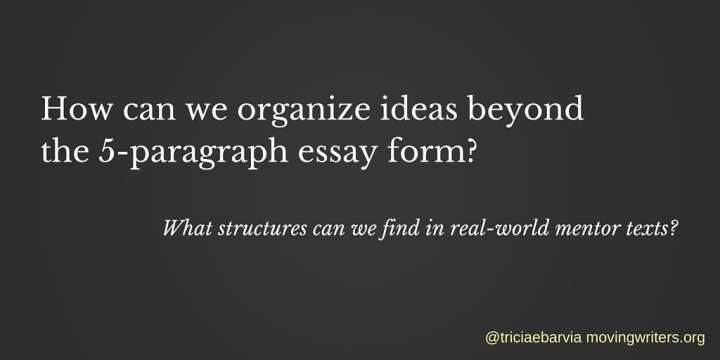
Structure as Mentor Text: How Can We Organize Ideas Beyond the 5-Paragraph Essay?
I’m so happy to share that starting this week, I will be a regular contributor to MovingWriters.org, a site dedicated to “move our student writers forward in their craft.” Moving Writers was founded by educators Allison Marchetti and Rebekah O’Dell, authors of the marvelous book, Writing with Mentors. I’m so honored to join Allison and Rebekah in this worthwhile endeavor. That said, below is the opening to my first blog post, posted yesterday. I hope you enjoy and continue reading at MovingWriters.org.
A few weeks ago, I came across a post on the Teaching and Learning Forum on the NCTE website. The conversation centered around the usefulness—or the lack of usefulness—of the five-paragraph essay. Comments varied, with many teachers chiming in with their thoughts, both fervently for and against the form.
I spent the first five years of my career teaching 9th and 10th grade. During that time, I focused my writing instruction on the five-paragraph essay. And I was good at it. I mean, really good at it. My students, through much practice, could put together a thesis statement with three reasons, write the three body paragraphs with corresponding topic sentences, and a conclusion which restated their main ideas (in case those ideas weren’t already clear).
Not surprisingly, years later when I started teaching AP Lang, my juniors walked into my classroom in September unsure how to write an essay using any structure other than the five-paragraph form.
How can we get students to re-read?
As I walk around the room, I notice students talking—generally enthusiastically—about the book we are reading. They have a few discussion questions on a handout to take notes, which they dutifully fill out. What I don’t notice are any books open on their desks. In fact, I see many students with no books out at all, and what books are out are closed on their desks.
“Mrs. Ebarvia, do you know remember what Piggy said to Jack when they went to Castle Rock?”
“Sure, I remember.”
Pause. Expectant looks.
“You know, you could open your book to find out,” I suggest. My students smile and begin searching their books.
Years ago, when I first read Kelly Gallagher’s Deeper Reading during the PAWLP summer institute, one particular section that stood out to me was the chapter on “Deepening Comprehension through Second-Draft Reading.” In this chapter, Gallagher emphasizes the importance of getting students to go back to the text to reread:
Students need to return to the text to help them overcome their initial confusion, to work through the unfamiliarity of the work, to move beyond the literal, and to free up cognitive space for higher-level thinking. They need both a “down” reading draft to comprehend the basics and an “up” reading draft to explore the meaning. (80)
Those who have been teaching English long enough know that getting students to go back to the text can often be a difficult task. Having gotten the “jist” of the story on their first reading, students often see no need to go back to the text unless prompted.
Yet we also know that rereading is one of the first steps towards a deeper understanding of a text. When students reread, they can better appreciate craft—they can see the choices that an author made and question why. When a text is complex and students don’t “get it” the first time, rereading is not only a valuable but necessary move that students can make.
So how do we get students to go back to the text—to explore the text a second, or even third time?
Getting out of the way: A line of argument
 One of my favorite essays in my AP Lang & Comp class is Amanda Ripley’s “The Case Against High School Sports,” originally published in The Atlantic. Ripley’s argument is particularly provocative as she questions the possible disproportionate value that schools place on sports versus academics. Conversation is always animated—students tend to feel strongly about the value of sports in schools, both for and against—and discussion can sometimes even get a little heated. Vigorous debate ensues.
Unfortunately, depending on the class, I’ve found that it can be hard for students—and really, for anyone—to look beyond their own points-of-view, especially the more invested they are in those viewpoints. The students who participate in sports feel defensive while the students who don’t participate in sports feel validated. As a teacher, I generally play “devil’s advocate” to any viewpoint students have—for or against—to try to challenge and extend their thinking.
Still, I often find that I’m doing too much of the negotiating and managing of class discussion. Even when most of what I’m doing is asking questions (versus asserting opinion), I’m still the one doing a lot of the “work,” so to speak. Read More
Getting out of the way: EdCamp-inspired discussion
The end of the week is finally here. I think I speak for most of my students and fellow teachers when I say that Friday couldn’t come fast enough. It’s been one of those weeks where every day I rushed to get things done, and yet wonder how much I really accomplished. Though I consider myself a generally positive person, when it comes to classroom time, I’m more of the “glass half empty” persuasion. In other words, I tend to worry about what didn’t covered in class. I think a lot of teachers are like that. There’s just never enough time tends to be a common refrain.
That said, I also know that the glass isn’t half-empty but half-full. As I reflect on the last few days, then, I thought I’d take a moment to hold on to what (I think) went well this week.
Last summer, I wrote about how I needed to do more getting out of the way—instead of being the proverbial sage on the stage, I’ve tried to be more cognizant about stepping to the side to allow for more student voice and ownership over what happens in the classroom. Less teacher-directed and more student-led activity—that’s the goal.
This week, I took a few humble steps in that direction, inspired by EdCamp. Read More
 Tricia Ebarvia
You must be logged in to post a comment.