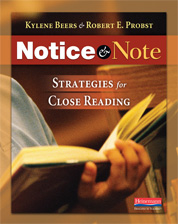
Notice & Note, then Write: A Blueprint

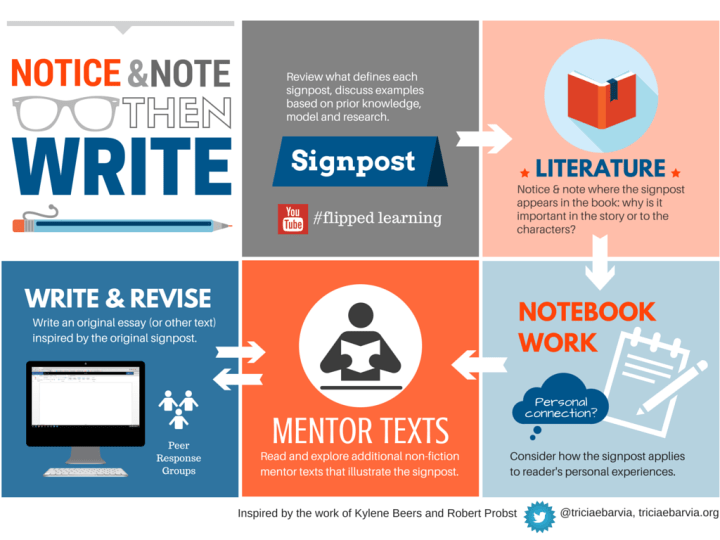
notice and noteI’ve been doing more thinking about how to use Notice and Note: Strategies for Close Reading to invite students to write. Since my last post on the subject, I’ve thought about how this would actually work―practically speaking―in my classroom. (If you are new to Notice and Note, read more about it here.)

My thinking so far:

PRE-WRITING: Beginning in our notebooks. Before officially talking signposts, we’ll take some time to do some notebook work. Doing so early will set the stage for the regular writing students will do in their writer’s notebooks all year. I’ll weave in quickwrites that address the signposts, though the students won’t know it yet. Some ideas:  Read More

From the Classroom: What Does Real-World Writing Look Like?

(Real World) Reasons-to-WriteSpeaking on a panel at the NCTE Annual Convention last fall, author Cris Crutcher commented, “Reading Shakespeare is an academic exercise. It’s not one that’s going to get me to love reading.” Though I disagree with him about Shakespeare―I think studying Shakespeare can give us tremendous insight into who we are as human beings and speak to us in profound ways―his remark did give me pause. How many of the things we assign―books, writing assignments―are no more than academic exercises?

Continue reading at Write . Share . Connect, the Pennsylvania Writing and Literature Project Blog.

Notice and Note: Invitations to Write

I ‘ve been rereading Notice and Note: Strategies for Close Reading as I look to teach and apply the signposts with my 9th graders (we introduce the signposts within the first few weeks of school). At the same time, I’ve also been reading the 3rd edition of Atwell’s In the Middle. Atwell’s book is so dense with wonderful ideas that it’s been taking me some time to work through it all. I find myself being constantly challenged as I read through both books, as I am forced to reconsider my past teaching practices and find inspiration for future ones.

notice and noteI was in the middle (pun intended?) of reading about Atwell’s list of writing territories when an idea occurred to me.  What if I adapted the idea of writing territories from Atwell and connected it to the signposts in Notice and Note?  In other words, instead of using the six signposts as tools for close reading, I could also use them as invitations for student writing. In this way, I can also capture some of the spirit of the writing territories Atwell points out are so important for students to develop as writers.

Here’s a rough sketch of what I envision: Read More

Mentors

Screenshot 2015-07-18 at 12.10.31 AMI’ve been giving a lot of thought recently to this word—mentor.

I’m one of those people who believe in signs. If the universe wants you to know something—to do something—the universe will find a way of making sure you know about it. And so it is with this word: mentor.

One the last day of school, I found myself staying late to finish packing. In the past, I’ve prided myself on being one of the first teachers out of the building once the official announcement has been made by our principal. This year, for whatever reason, I didn’t find myself in as much of a hurry. I like to think of it as a kind of maturity—how, I’m not exactly sure—but more likely it was that I just hadn’t finished packing yet.   Read More

Reading Challenges Visualized

Last week, I had the pleasure of presenting at the PA Writing & Literature Project (PAWLP) Summer Institute on using visual tools in multigenre composition. One of the visual tools that I discussed was the use of infographics. Then in my Twitter feed this past weekend, I came across Cheryl’s Mizerny’s list of reading challenges for her students. I’d been brainstorming a similar list in my writer’s notebook, but seeing Cheryl’s list motivated me to finally put the finishing touches on my own for my students. Read More

New Yorker Inspired Writing

Yesterday afternoon while I skimmed and scanned my inbox, I came across Lena Dunham’s latest piece for The New Yorker—”The Bride in Her Head“—a wonderful essay in which she examines her changing attitude toward marriage, reflecting on her own personal life particularly in the context of the Supreme Court’s recent ruling on gay marriage. It’s an example of the type of engaging personal essay that I want my students to write. Dunham draws from current events as occasion for deep, personal reflection. Read More

My ISTE experience: First the bad news…

I’m currently working on a presentation I’m giving for a digital writing course and reflecting on my experience at the ISTE conference, which I attended last week. It was the first time I’d ever attended an ISTE conference. As with most conferences, I came away feeling overwhelmed. One morning, as I stood in line at the EcoGrounds coffee stand (doing my part to help the environment, according to their signs), I glanced at the person next time me and saw her name tag. She had a sticker attached that read “My head is going to explode.” I suspect many people were feeling the same way. I know I was. Read More

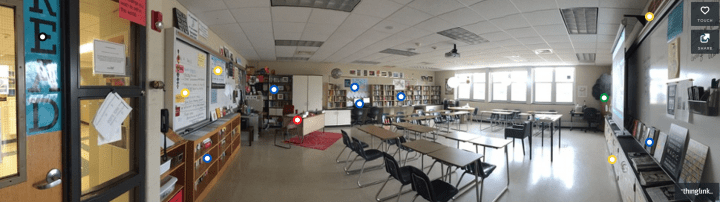
A Virtual Tour through Thinglink

I first heard about Thinglink from my teacher/writing project friend Jen Ward, and I finally decided to try it out myself this summer. So to practice, I used a picture of my classroom I had taken earlier this year and made it “touchable” (I think that’s the right Thinklink term).

For whatever reason, I can’t get the Thinglink to embed, but clicking on the link below takes you right there.

Thinglink