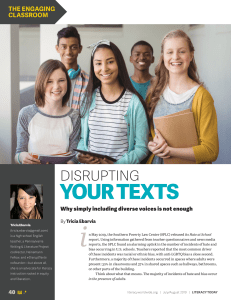
Why Diverse Texts Are Not Enough

NOTE: This post was originally published and written for Literacy Today, a publication of the International Literacy Association (ILA). Click on the image at the right to download or print a PDF of the original article (and click here browse the entire issue).

In May 2019, the Southern Poverty Law Center (SPLC) released its Hate at School report. Using information gathered from teacher questionnaires and news media reports, the SPLC found an alarming uptick in the number of incidents of hate and bias occurring in U.S. schools. Teachers reported that the most common driver of these incidents was racial or ethnic bias, with anti-LGBTQ bias a close second. Furthermore, a majority of these incidents occurred in spaces where adults were present: 32% in classrooms and 37% in shared spaces such as hallways, bathrooms, or other parts of the building.

Think about what that means. The majority of incidents of hate and bias occur in the presence of adults.

Read More

How do we show up?

“Your racial consciousness determines how you show up.”

A few weeks ago,  a small group of teachers—all of us teachers of color—gathered for dinner with Tony Hudson, an Equity Transformational Specialist from the Pacific Education Group (PEG). This year, our district partnered with PEG to facilitate the courageous conversations about race that our schools—and really, all schools—need to have in our classrooms, buildings, systems. During our conversation, Tony pointed out this simple truth: “Your racial consciousness determines how you show up.”

I wrote that line down and have been turning it over in my head ever since.

What does it mean to “show up” in anti-racist work? What does it mean to “show up” in educational spaces—educational spaces which (of all places) should be inherently anti-racist but are often not? And why not?

As long as teachers continue to show up in classrooms racially unconscious, educational institutions will continue to be spaces that perpetuate racist systems and inequities.

Because your racial consciousness determines how you show up.

Read More

Summer, home: A Poem by Joel Garza

I:

Daniel was the son
raised in the valley. A bucket for a
swimming pool. Air conditioning was
hosing down the cement porch,
waiting for a breeze. Him and Mom,
Granny and Papá Romulo.
Then Dad returned from the war. That’s all
I know of the war.
__________His return.

Raul was raised in San Antonio.
Daniel & Raul,
speaking Spanish, singing boleros,
eating raspas, and parting their hair on the side.
Los hijos de Junior y Noelia.
Tan joven, tan guapo.
They knew the valley, they knew
the language.
__________I came late. Learned late.

Read More

We Teach Who We Are: Unpacking our Identities

Reading a few conversations online recently, I’ve been thinking a lot about the urgent need for us as teachers to do some hard, internal work of unpacking the identities we bring to the classroom. More and more lately, I’ve seen teachers get defensive in conversations about curriculum, which I’ve come to realize are often really conversations about racism, sexism, classism, and other issues in which arguments about books and the canon have become a proxy.

Teaching is an intensely human activity. The best teachers are those who know that teaching—and students—cannot be standardized. Giving two teachers the same curriculum and asking them to follow it “with fidelity” is an impossible task. Not only are the teachers different individuals, but they’re also charged with the care of dozens of individual children.  We teach who we are. This is what can make our practice so powerful—even transformative—but also potentially dangerous.

We bring all of our identities—and the experiences that informed them—into our teaching. So we have to interrogate the ways in which these experiences have shaped our practices and our relationships with kids. These experiences are those that gave us opportunities to be educated ourselves, which eventually led to our teaching “credentials.” It’s this professional learning and all our years in the classroom that we draw upon when we make decisions. We draw upon our years of kid-watching and theory-making.

But I would argue that it’s often our personal identities and experiences that have the most profound effects on our teaching, and that which most often—and most dangerously—go unexamined. Read More

Disrupting Texts as a Restorative Practice

One of the wonderful things that the #DisruptTexts chat has brought is opportunities to talk with teachers about what disruption can look like in the English classroom. Yesterday was one of those days as our team was invited to talk with teachers at an NCTE Summer Institute workshop run by Ken Lindblom and Leila Christenbury called “Continuing the Journey: Becoming a Better Teacher of Literature.”

Yesterday at the workshop, Ken opened with the question, “What does it mean to #DisruptTexts?” My initial response was to frame it within the context of our classrooms. And so #DisruptTexts for me involves at least two related and necessary moves: Read More

A thought experiment on our reading lives

I‘ve been in a serious writing slump over the last year or longer. I don’t know what it is. I joked with a friend that since I’ve been engaging and thinking more on Twitter that I’ve only been able to think in 240 characters at a time. It’s become a real problem.

But someone suggested seeing the micro-writing I’m doing on Twitter as small, rough drafts—pieces of thinking, some scrappier than others, that I might be able to reflect upon, cobble some thoughts together, and then explore a bit deeper. A few days ago, I posted a thread reflecting on the diversity of my own reading life, so I want to include those thoughts and expand a little on them here.   Read More

Strategies to Dig Deeper

Thank you so much to Dr. Aileen Hower who asked me to be a part of Millersville University’s Summer Literacy Institute this year! Loved working with such a great group of teachers on their last day on writing strategies to get to students dig deeper. Click HERE for the full slide deck. NOTE: Permission to use with written request and proper attribution.

Heinemann Fellows Capstone Presentation

In June 2018, the second cohort of Heinemann Fellows presented their action research Capstone presentations in Portsmouth, NH. No words will ever fully capture the way this experience has transformed my professional and personal life. I will forever be grateful to Vicki Boyd and Ellin Keene for bringing the eleven of us together to reflect and examine our most urgent work in our classrooms. While I am saddened at the end of this stage in the process, I am excited for the many opportunities for continued learning ahead.

Click HERE to view the slides from my Capstone Presentation.

Student-Led Mentor Text Talks

We have officially arrived at the point in the year where panic ensues. The fourth marking period is here and there is still. so. much. to. do. And with the additional pressures of AP and state testing season, to say I’m feeling overwhelmed would be an understatement.

The truth is that it’s when the going gets rough that I tend to slip back into a more teacher-directed instructional style. It makes sense, after all; as the sage-on-the-stage, I can control the pacing of the class and how much time we spend — or don’t spend — on any particular activity. Free-flowing conversations? Write to explore? Who has time for that when the clock is ticking?

But that’s when I take a deep breath and remember that any heavy lifting I’m doing at the end of the year is only heavy when I’m the one doing all the work. More than ever, it’s time like this that I need to engage students as active learners — to get them up, moving, talking, walking.

So here we are with only a few weeks to go, and in my AP Lang class, there are still so many wonderful essays and mentor texts that we have yet to read. Ideally, with more time, my students and I could spend 1-2+ days discussing each text. So my dilemma was this: how could I maximize the number of high quality mentor texts they could read but also give them the time needed to dive into a deep study about craft and style?

CLICK HERE TO CONTINUE READING ON MOVINGWRITERS.ORG.