Prewriting Using Modes

My AP Lang students are currently working on their “On” essays—writing on anything they choose.

There’s a long tradition of “On” essays in the world… and by an “On” essay, I mean any essay whose title starts with the word “On…” (although, really, isn’t anything an “On” essay if it’s on a topic? The distinction for my purposes in teaching is really just technical). We read essays like “On Keeping a Notebook” by Joan Didion and “On Dumpster Diving” by Lars Eighner, which explore process. We read a contemporary essay like “On Compassion” by Barbara Ascher and a 19th century essay like “On Running After One’s Hat” by G. K. Chesterton, which delve into the philosophical as well as social commentary. We read “On Being a Cripple” by Nancy Mairs and “On Being Black and Middle Class” by Shelby Steele,” which focus on identity. We read essays by Lewis Thomas, whose essays,“On Warts” and “On Probability and Possibility,” are some of the best examples of elegant science writing—and writing in general—I’ve encountered. And still we read other essays whose titles don’t begin with the word “On” but embody the ethos of writing on what it means, ultimately, to be in the world—essays like “The Jacket” by Gary Soto and “Me Talk Pretty” by David Sedaris and “Salvation” by Langston Hughes.

We study and celebrate these writers and their craft. We ask ourselves questions that help us read like writers: What can I take away from this? What can I learn? What can I steal? Because my AP Lang students read Austin Kleon’s Steal Like an Artist for summer reading, we remind ourselves to embrace being artistic thieves. We look at the ways in which these essays explain, define, and describe; how they use anecdotes and allusions; how they feature both insight and curiosity; how they zoom in and zoom out. Read More

Conferring as Prewriting

I was reminded the other day of the work of Don Murray (who, with Don Graves, I affectionately refer to as “the Dons” in my head). “Prewriting usually takes about 85% of the writer’s time,” Murray wrote in his wonderful essay, “Teaching Writing as a Process Not Product.”

As my students begin work on one of their first major essays this year, I keep coming back to Murray’s words. 85% of writing is prewriting. I remind myself of this fact as I panic a little, worried that it’s already October and my students are only just beginning one of their first major essays this year. What have we been doing for the last few weeks? I ask myself. Students need to write, and write a lot, in order to become better writers, so why did it take so long to get to this first essay? It’s already October! I panic a little more. It’s almost November! I start to hyperventilate.

And then I take deep breaths and remember Murray: 85% of writing is prewriting. And then I remember that it’s not as if my students haven’t been writing, writing, writing for the last seven weeks. “Never a day without a line,” another Murray quote, is our class mantra. We’ve been writing every day—filling our writer’s notebooks, creating lists, making observations, drawing heart maps, reflecting on memories, asking questions, lifting lines, recording wonderings, sorting through worries, playing with language, exploring writing territories, and most of all, finding voice. By doing all these things and more, students can begin to unearth those “moments worth writing about” that will carry them through the rest of the year as they become writers.

CONTINUE READING AT MOVINGWRITERS.ORG

Writing in the Wild: Beyond the 5-Paragraph Essay

“What do you think about when you hear the word essay?”

A moment of silence. Some confused looks. Others, blank stares. A few, smirks.

IT’S LATE AFTERNOON, September, last period. My AP Lang class and I are in the midst of finishing up our discussion of Joan Didion’s wonderful essay, “On Keeping a Notebook.” It’s a relatively small class: twenty-one mostly juniors who come together at the end of each day to read, write, talk, laugh, and yes, learn. It’s one of those classes that—less than a month into the school year—has already started to feel like a writing community.

“I like to start the year with ‘On Keeping a Notebook’ for a few different reasons,” I tell students. First, I explain, we’ll be keeping our own notebooks throughout the year. Our notebooks are the building block of our writerly lives, and I encourage students to use their notebooks beyond our classroom walls. For Didion, a notebook was a place to remember how it felt to be her. As she points out, “We forget all too soon the things we thought we could never forget. We forget the loves and the betrayals alike, forget what we whispered and what we screamed, forget who we were.”

Thus, I encourage students, “Don’t wait until class to add something to your notebook. It’s yours. Don’t let it be a place that only has writing prompts from Mrs. Ebarvia.” (Side note: Talking about myself—or my teacher-self—in the third person is becoming habit, I fear. I wonder what it means).

CONTINUE READING AT MOVINGWRITERS.ORG.

Never a day without a line

“Never a day without a line,” Brenda repeated.

In the summer of 2011, I had the pleasure of participating in the PA Writing and Literature Project Summer Invitational Writing Institute. Although I’d been teaching for several years by then, my experience with the writing project that summer was the first time I started to think of myself not just as teacher of writing, but as a writerwho teaches.

The truth is that I had been always been a writer. I’d kept journals and notebooks and diaries for years. And as an English major, I’d also written my fair share of essays, papers, and assorted assignments. But in my mind, none of these things qualified me to be a writer. Writers publish their writing; they write books and for newspapers, magazines, and journals.

That changed when I participated in the writing institute. Which brings me back to Brenda. Brenda Krupp, a third-grade teacher and co-director of the writing project, facilitated the institute that summer. Her boundless energy and passion for not just her students’ writing lives but also our own—as teachers, as colleagues—was palpable. Although she taught us many things those four hot weeks in July, if I had to choose one thing that I will always remember, it’s the words she shared from writing legend, Don Murray: “Never a day without a line.”

CONTINUE READING AT MOVINGWRITERS.ORG.

Reimagining Learning Spaces: The Third Teacher

A few years ago, I started to rethink my classroom space. I wondered, What does this room say about me as a teacher, or my students as learners? Is the space working in the best ways in can? Although I don’t think I realized it then, I now know that those questions stemmed, in part, from being in my own children’s classrooms.

As a parent with three boys in elementary school, I am always amazed on back-to-school nights. Every classroom is bright and cheerful. The moment I walk in, I know that this is a place where children are valued—where their voices are heard and their spirits nurtured. Every space in the room is meaningful. Inspirational quotes line the walls alongside student work. Other spaces feature word walls, classroom jobs, anchor charts, learning stations, reading nooks, a class pet, and cozy chairs.

Although you certainly don’t need to be a parent to be a good teacher, in my personal experience, seeing school through my children’s eyes shifted my thinking in subtle but significant ways. When I became a parent, I became a better teacher. For one, I became more compassionate; when I think about the 15- and 17-year-olds sitting in my classroom, I see them not only as my students but also as someone else’s children. When I make instructional decisions, I can’t help wonder, Would I want this for my own boys?   Read More

A Place to Belong

Recently, I was honored to be among the contributors to Education Week’s Classroom Q & A with Larry Ferlazzo. This week’s question was, “What’s the best way to start the school year?” Below was my response.  Be sure to follow the link at the end to read other teachers share their thoughts on a successful back-to-school. 

Even though I’ve been teaching for 15 years, as September approaches, I still get that same feeling of nervous excitement that I had my first year teaching. In fact, it’s the same feeling I had as a student, too. I don’t think I will ever forget what it was like to be 14-years-old—a new student transferring from a small parochial school to a large public high school, from a class of 28 to a class of 200. Particularly vivid are my memories of those dreaded extended homeroom periods during the first week of school. As everyone else exchanged tales of summer vacations, I stared at my shiny, laminated official school folder and read the lyrics to the school’s fight song over and over again.

As I begin another school year, I try to remember my 14-year-old self—her awkwardness, her fears, but also her hope. The hope for new friends, caring teachers, and a place to belong. I think it’s because of my 14-year-old self that I try to start each school year by identifying the students who may need a little more than a warm-but-generic welcome back to school. Too often, in the busyness of daily teaching, I’ve been guilty of asking “how are you?” but not really listening for the answer in a way that honors the question—or the person—as I rush to answer emails or make copies. Read More

Zen Teaching

NOTE: This post was originally published on MovingWriters.org. Follow the link at the end to continue reading.

Now that it’s officially August, I’m starting to feel what I suspect many teachers feel this time of year—the all too familiar mix of anxiety and anticipation. While I use this time to cross off items on my summer bucket list—beach getaways, sticky popsicles, and poolside naps—I also use summer to reflect on all the things that could have gone better last year and the changes, big and small, I can make starting on day 1. I wonder about the students who will fill my classroom—and my life—in just a few short weeks. Who will they be? What will they be like? And how will I reach them?

These are just a few of the questions that go through my mind as I plan for next year. As I flip through pages of pedagogy books and teacher websites, my notebooks team with ideas. Ideas for independent reading, prompts for notebook writing, and of course, lists and lists of mentor texts. Yet while discovering new ideas energizes me, it also overwhelms. And I wonder—maybe you can have too much of a good thing.

Too much of a good thing. When I first started teaching, the hardest part was always feeling like I didn’t have enough—enough support, enough materials, enough ideas. I’m so thankful for the mentors who nurtured me during those early years. Now, fifteen years later, it’s not a matter of having too few ideas but too many. Even a cursory glance through favorite Twitter hashtags, teacher blog sites, and online workshops speaks to the abundance of ideas in the connected educator world—and to the generosity of so many talented teachers who share their work with open hearts.

So as I enter another year of teaching, and with so much rich material out there—how can we make sense of it all?

THE THREE QUESTIONS

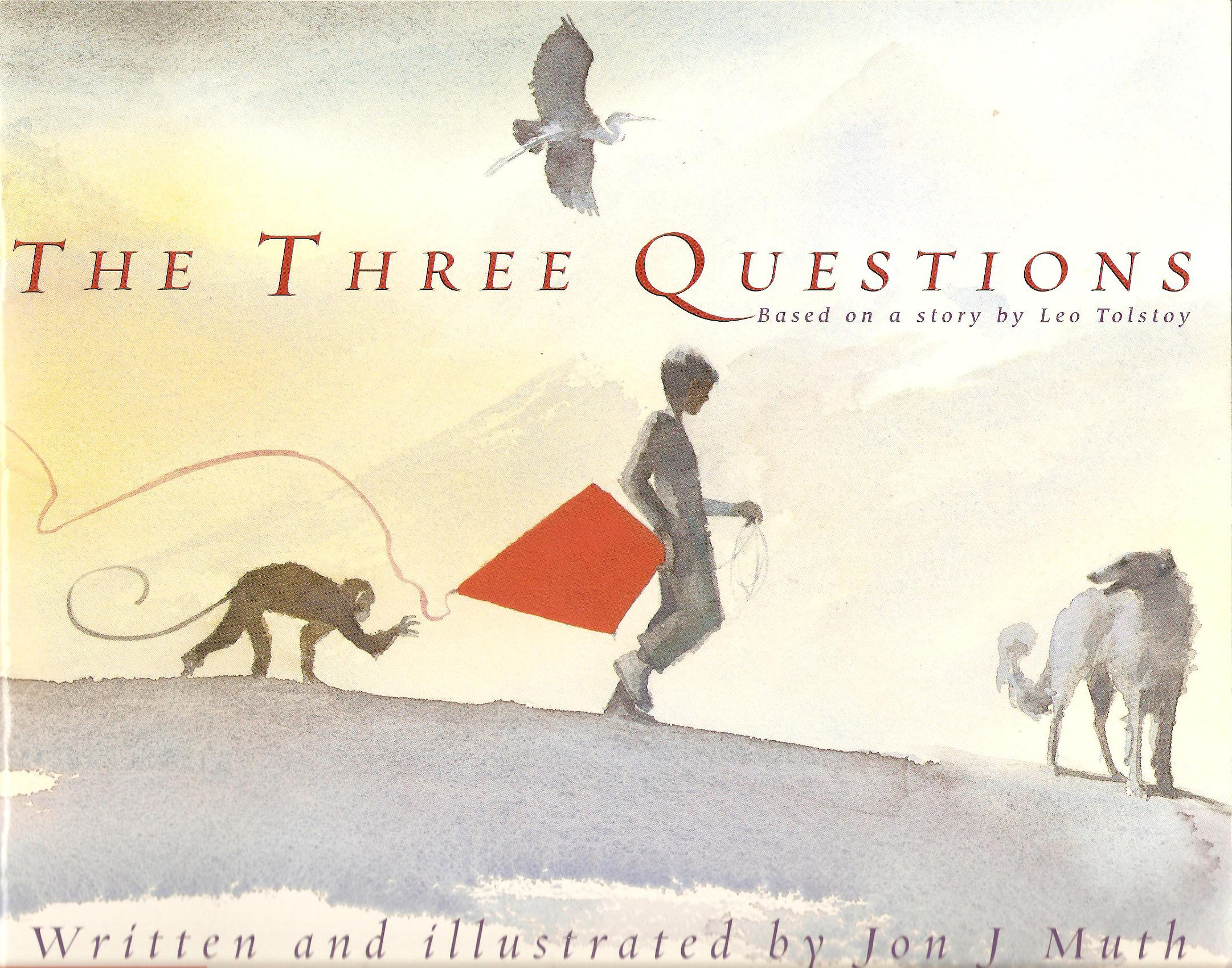
Last spring, I surprised my 9-year-old by coming in as a guest reader to his third-grade classroom (and yes, he was dying with appropriate embarrassment). One of the books I brought with me to read was The Three Questions by Jon Muth. Although we’ve had the book for years, I actually couldn’t remember the last time that I’d read it to my son, so it seemed like a good choice. And if you are familiar at all with Muth’s work—Zen Shorts, Zen Ties, Stone Soup, among others—you know that his work is simply beautiful, with his signature watercolors and whimsical characters.

Screen Shot 2016-08-14 at 10.12.36 AM
three-questions-front-page2-12hfsjmThe Three Questions, published in 2002, is a retelling of Leo Tolstoy’s classic story of the same name. In the original story, a king wants to know how to best rule. From the opening paragraph:

It once occurred to a certain king, that if he always knew the right time to begin everything; if he knew who were the right people to listen to, and whom to avoid; and, above all, if he always knew what was the most important thing to do, he would never fail in anything he might undertake.

Thus, the king seeks wisdom from an old hermit whom he believes can give him the answers. The hermit does not answer the king’s questions directly; in fact, in a very Mr. Miyagi-like move, the hermit engages the king in work that is meant to reveal the answers. By the end of the story, under the hermit’s guidance, the king saves the life of the enemy who intended to kill him, thus not only avoiding war but gaining a friend.

In Muth’s retelling, the king is not a king, but a young boy named Nikolai, who asks himself the following three questions:

What is the best time to do things?

Who is the most important one?

What is the right thing to do?

Like the original king, Nikolai first seeks answers from those around him. In Muth’s retelling, three animals—Sonya, a heron; Gogol, a monkey; and Pushkin, a dog—each give him wise, if not conflicting, advice. Confused, Nikolai then seeks the “hermit” figure in this version, a wise old turtle aptly named Leo. Though Nikolai is confused by Leo’s evasive non-answers, Nikolai ultimately discovers the answers to the three questions on his own. The stakes are a little less dark in this version—there is no enemy sent to kill Nikolai—but the lesson is important nonetheless.

When Nikolai first meets Leo, he finds the old turtle laboring in his garden. Nikolai takes the shovel from Leo to help and continues the digging himself (symbolism!). While he works, a storm rains down, and the two seek refuge. However, Nikolai hears the cries of a hurt Panda nearby. Nikolai drops everything to help the Panda, and there’s a wonderful page depicting Nikolai struggling to carry the too heavy panda inside. When the Panda tells Nikolai that her child is still lost outside, without hesitation, Nikolai braves the storm and ultimately reunites mother and child.

three questions 4

Enter dramatic irony, for the following morning, Nikolai still doesn’t know the answers to his three questions, even as the answers have guided his actions. Leo points out that had Nikolai not stopped to help the old turtle with his garden, Nikolai would not have heard the panda’s cries for help. Thus, Leo tells him, “the most important time was the time you spent digging the garden. The most important one at the moment was me, and the most important thing to do was to help me with my garden.”

Likewise, the wise turtle continues, “when you found the injured panda, the most important time was the time you spent mending her leg and saving her child. The most important ones were the panda and her baby. And the most important thing to do was take care of them and make them safe.”threequestions1

ZEN TEACHING

So you might be wondering—and understandably so—what does a story about a boy, a turtle, and some panda bears have to do with teaching? (I thought this was a blog about mentor texts and writing!)

This post was originally published on MovingWriters.org. CLICK HERE to continue reading (and check out some of the other wonderful teachers there who share their best practices for writing instruction). 
What do we hope for our student readers?

I‘ve been thinking and writing a lot lately about how our beliefs about students, learning, and teaching influence our practices. Part of this reflection has stemmed from my own instructional practice and how it has shifted—in subtle but also dramatic ways. How, for example, the nagging questions I’ve had about the 5-paragraph essay template have been pushing me toward more authentic writing. Or how seeing my students experience joy and independence with choice reading has pushed me to build a classroom library. As I’ve posted elsewhere, my reflection on the connection between my beliefs and practices has also been fueled by some recent professional development experiences, like hearing Will Richardson challenge us to make schools relevant to the students sitting in our classrooms today and reading Heidi Mills and Tim O’Keefe’s essay “Why Beliefs Matter” in The Teacher You Want to Be.

Of course, I am just one person—one teacher who, at the end of each day, is doing what she believes is best for her students. I’m not unique in this. I think most teachers are the same—we do what we believe is best for children.

And yet if we’re really honest with ourselves, we have to admit that sometimes we believe is best is not what’s reflected in our classrooms. Read More

The Pressure to Do Versus the Possibilities of Doing

Whenever I blog, especially for PAWLP, I try to offer fellow teachers some practical strategies to use in the classroom. After all, I know how I much I appreciate picking up ideas that I can try with my own students right away, sometimes even the very next day.

Of course, now that summer is just about here—tomorrow is our last official day with students!—there is no more “very next day.” Instead, as the weather warms and lazy days at the pool run together, the planning for next year begins. Sometimes the planning is purposeful: reading pedagogy texts or writing up lesson ideas. But other times, the planning is a little more serendipitous: stumbling upon the perfect article for class or finding inspiration while on an errand to the store. Summer may be here, but I’ve found that my “teacher brain” never really goes on vacation.

Without the pressure of “the very next day,” the ideas I come across during summer have room to sit, and breathe. There’s no pressure to do—simply the possibilities of doing. The extra time summer offers allows me to think this could work or maybe I’ll try this or what could that look like?

Summer, then, becomes a time to reflect on another year gone by and to gather new ideas for the year ahead. How? Below are just a few of the things I’ll be doing this summer to reflect and re-energize:

CONTINUE READING AT PAWLPBLOG.ORG.